You don't need a computer science degree. You need a plan.
The honest truth about app development
Most people don't fail because of the tech.
They fail at the moment they open Terminal for the first time, see three error messages at once and decide: This isn't for me.
That's a mistake.
Not because Terminal is easy. But because in 2025 you no longer need to understand Terminal to build an app that real people use.
I'm not talking about no-code toys that look like a school project from 2019.
I'm talking about native apps. With haptic feedback. Cloud backend. Authentication. Push notifications. The whole machinery.
In hours, not months.
The framework nobody explains to you
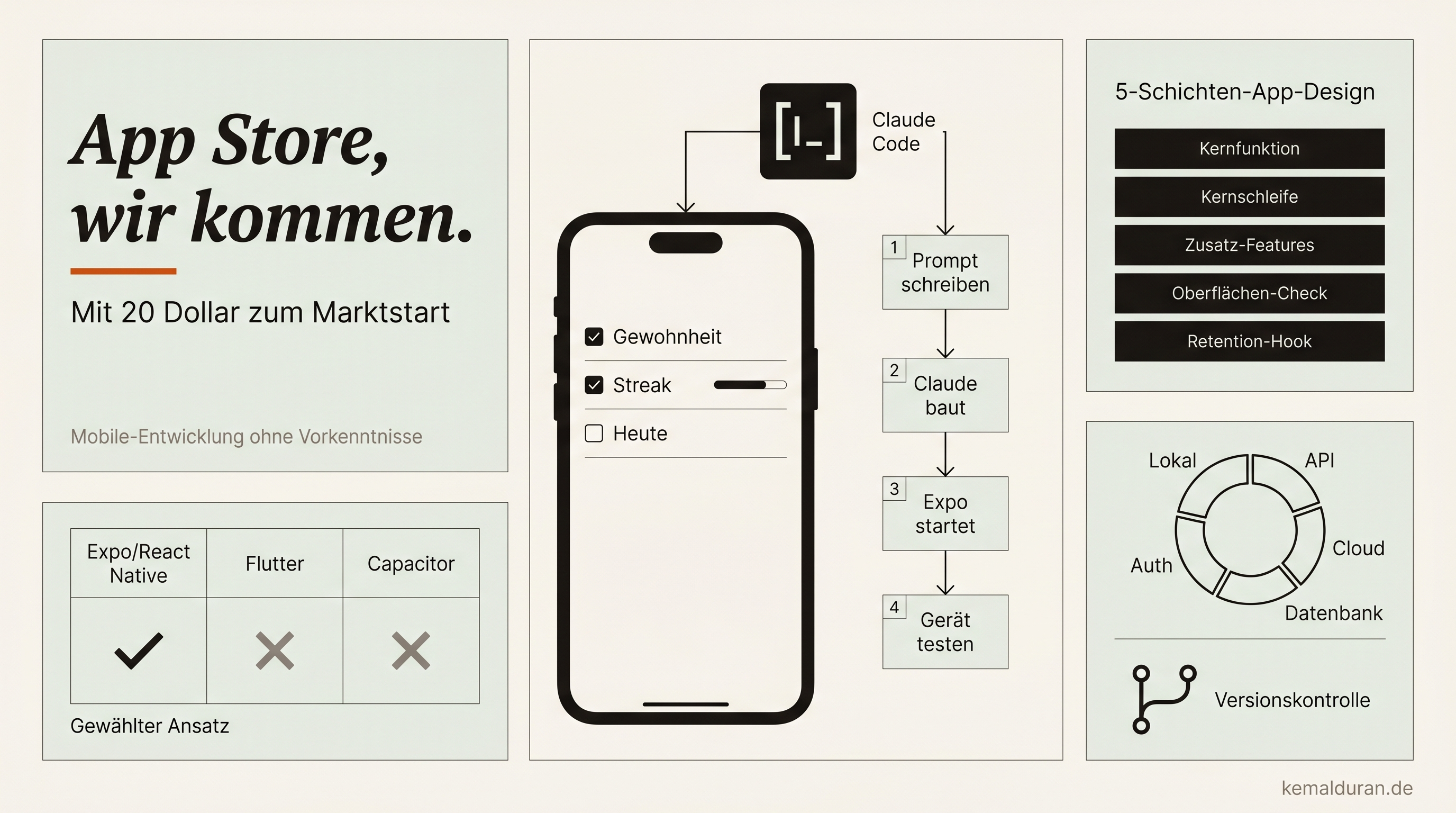
Before you open even a single tool, you need five answers.
Not rough answers. Precise ones.
First question: What is the one core function of your app?
Not five functions. One. The one without which your app stops existing.
Second question: What is the core loop, the cycle the user goes through every day or every week?
An app without a loop is a tool. Tools get used when you need them. Apps get opened because you're hooked on them. That's a difference of several orders of magnitude in retention.
Third question: Which accessory features make the difference without overloading the core?
Fourth question: What is your surface area? How much can the user see, touch and understand in the first 90 seconds?
Fifth question: What is your retention hook? The mechanism that brings the user back tomorrow.
If you can't answer these five questions before you start building, you're building scope creep. You're building something that, after two weeks, looks like a Franken-product made of twelve half-finished ideas.
I know this. I've done it.
The layer you do need
Once the framework is in place, the building starts.
Not by you. With you.
The shift that changes everything: you're not the assistant. You're the architect.
Too many people open an AI tool and ask: How would I do this? They get instructions back, copy commands, run them, see errors, ask again.
That's the old way. The slow one.
The new way: Do this for me. Open a terminal. Install the dependencies. Create the repo. Push the first commit.
Direct delegation instead of step-by-step imitation.
That sounds like a small thing. It isn't. It's the difference between four hours and four days for the same result.
Why the device in your hand matters more than the browser
This is where the most common mistake in app projects happens.
You build in the browser. It looks good. You're happy with it. You show it around.
Then you load it onto a real phone.
And suddenly: your thumb can't reach the most important button. The scrolling feels mechanical. The haptic feedback is missing. The app feels like a website in disguise.
Because that's exactly what it is.
Every app iteration has to be tested on the physical device. Not at some point at the end. With every significant change. Right away.
That's not philosophy. That's craft.
A carpenter who builds a chair and only checks at the end whether it holds weight isn't a carpenter. He's someone who wastes wood.
The memory that saves tokens
One problem with longer projects using AI tools: every new session starts from scratch.
The tool doesn't know what was decided in the last session. It scans all the files again. That costs time, money and context.
The fix is simple: living project documentation.
After every significant build step, the architecture description gets updated: file structure, app logic, dependencies, latest decisions. Then the context gets cleared.
The next session starts compressed, precise, without redundancy.
This isn't a nice extra. In complex projects with a database, an API layer and authentication, it's the precondition for keeping the whole thing from falling apart.
Version control is not a developer thing
Last warning. Important warning.
When AI tools write and change code on their own, mistakes happen. Not rarely. Regularly.
A single badly worded prompt can push a working app into a state that no further prompt can repair.
Without version control there's no way back.
With version control a mistake costs five minutes.
Have the repository created for you, commit after every stable version, and just roll back when something regresses. That's the insurance you buy before you need it.
What this means for you
You don't have to become a developer.
You have to understand how products are thought through. How loops work. How people build or break habits. How an app feels in your hand, as well as in the browser.
That's not a technical skill.
It's design thinking. Product thinking. And a bit of common sense.
Someone else handles the tech.
You say what should be built. And why. And for whom.
That has always been the part worth the most.
It used to be hidden behind a wall of complexity that most people never got over.
That wall no longer stands.
FAQ
Can I build an app even if I can't code?
Yes, with AI tools that write and run the code for you. You take the role of the architect and set out what should be built and why. The tool handles the technical side for you: terminal commands, installation and deployment.
What is a core loop in an app?
A core loop is the action a user repeats on a regular basis, for example daily or weekly. It's what separates an app from a plain tool. A tool only gets used when needed. An app with a good loop gets opened out of habit.
Why should I test an app on a real device and not in the browser?
In the browser you miss information like thumb reach, scroll feel and haptic feedback. An app that was only tested in the browser often feels like a website in disguise on a real phone. That's why every larger change should be checked on the physical device right away.
Why do I need version control if an AI writes my code?
Version control is a system that saves every change to your code and lets you get it back. When an AI changes code on its own, mistakes happen regularly, and some of them can't be fixed without rolling back. With version control a mistake costs only a few minutes instead of the whole project.
What does living project documentation mean in AI projects?
Living project documentation is a file that keeps a running record of the project's architecture, latest decisions, file structure and dependencies. It gets updated after every important build step. That way the AI doesn't have to rescan all the files in a new session, which saves time and context.