Your AI agent makes mistakes. Because you don't give it a plan.
The mistake happens before the first prompt
You open the tool.
You type what you want.
The agent gets going.
And somewhere around minute four you notice: it's not doing what you meant.
Not because the agent is bad.
But because you didn't give it a plan.
That's the difference between people who are frustrated with AI agents and the ones who get real results with them. Not the tool. Not the model. The preparation beforehand.
What a plan means for an agent
A good brief for an agent isn't a sentence.
It's a document.
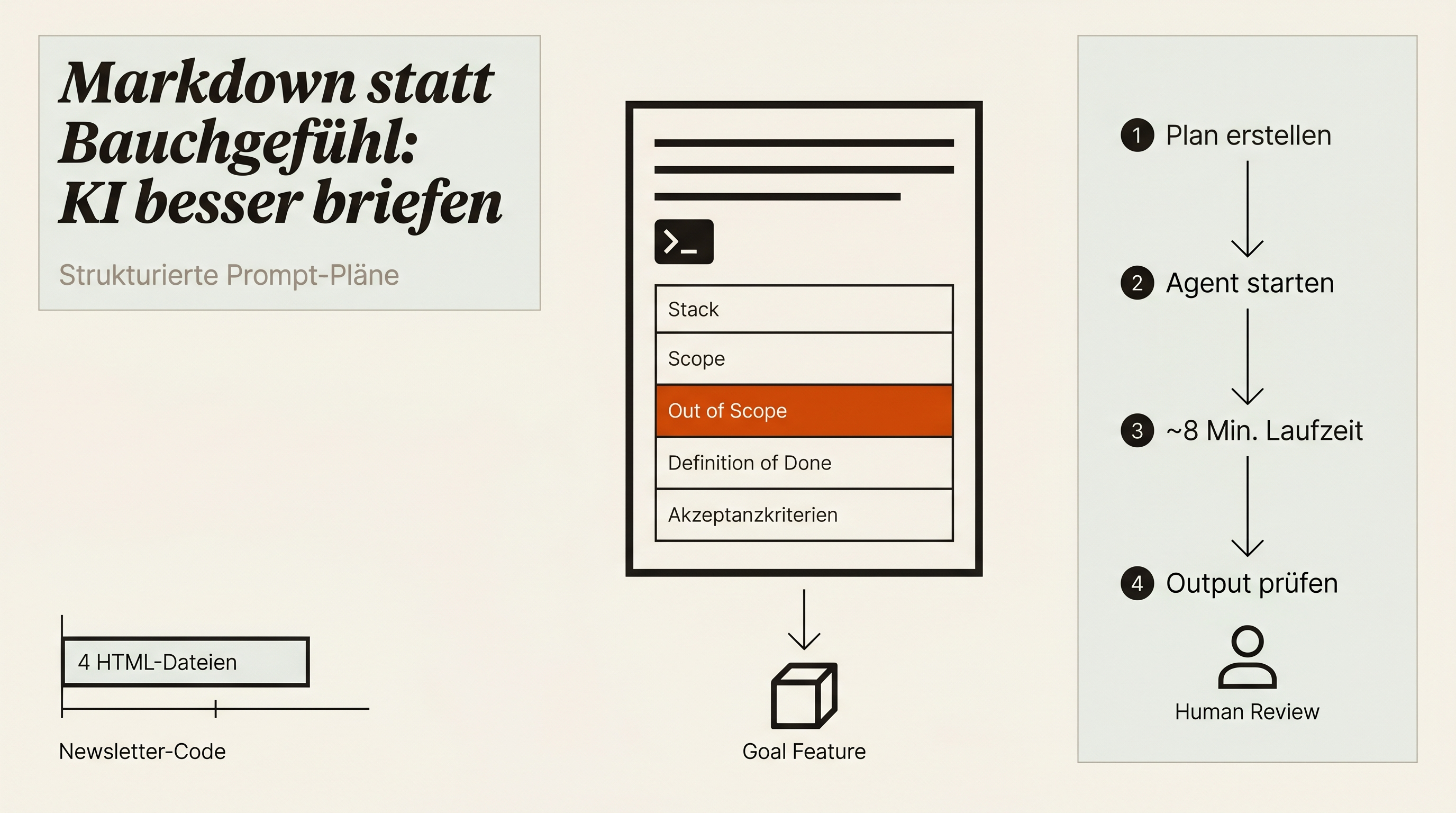
Specifically: a Markdown file with clearly defined fields that the agent works against.
The relevant fields:
Stack: Which tools, languages, formats are involved?
In Scope: What should the agent deliver?
Out of Scope: What should it explicitly not touch?
Definition of Done: When is the job finished?
Acceptance Criteria: How do I tell that the result is good?
Key References: Which documents, templates, style guides should it know?
Each of these fields has a function. None of them is optional.
The field most people leave out is "Out of Scope". That's exactly the mistake. If you don't say what the agent shouldn't do, it fills the gap itself. Sometimes correctly. Often not.
In practice: newsletter output in eight minutes
I tested this workflow on a newsletter job.
Goal: four HTML files for a newsletter send, structured, formatted, ready for review.
The plan was a Markdown file. The Key References field linked to an internal document with the style rules, formatting specs and content requirements for the newsletter. That gave the agent more than a task. It had context.
The run took eight minutes.
At the end: four files, ready to pick up.
No hours of back-and-forth. No prompt ping-pong.
Why human-in-the-loop isn't a contradiction
Fully automated sounds good. But it isn't, when you produce content that goes out under your name.
This workflow has a clear review gate. The agent delivers the raw version. I pick the subject line. I check the content. I decide what gets sent.
That's not a sign of distrust in the tool.
It's clean quality control.
Automation doesn't mean: the human disappears.
It means: the human decides at the points where it counts.
The agent handles everything else: the groundwork, the formatting, the structure.
What you can change tomorrow
Before you start an agent next time:
Create a Markdown file. Fill in the six fields. Link the relevant documents in the Key References field. And write down explicitly what the agent should not do.
Then start.
The difference from a freeform prompt isn't subtle.
It's measurable.
The real skill
AI agents are getting better. Fast.
But the ability to write a clean plan, define a clear scope, build in a review step: that stays human work.
Learn it today and you'll delegate effectively tomorrow.
Ignore it and you'll keep wrestling with outputs that are somehow off.
Structure before start.
Plan before prompt.
That's the workflow.
FAQ
What is a plan document for an AI agent?
A plan document is a written spec, usually a Markdown file, that tells the agent exactly what to do and what not to do. It contains fields like Stack, Scope, Definition of Done and Acceptance Criteria. Without this document, the agent fills gaps on its own and makes its own assumptions.
Why should I define Out of Scope when what I want is for the agent to do a lot?
Out of Scope protects you from the agent touching areas you didn't mean. Without that boundary, the agent fills unclear spots with its own logic, and that often leads to wrong results. A clear frame makes the output more predictable, not smaller.
Does human-in-the-loop mean the automation isn't working properly?
No, human-in-the-loop isn't a sign of bad automation. It means the human makes targeted decisions at the points that count most, such as the final sign-off on content. The agent still takes care of the groundwork and formatting.
How long does it take to run a newsletter agent with a good plan?
In the example described, the agent needed eight minutes with a structured plan document to create four finished HTML files for a newsletter. That time comes from a specific test run by the author and isn't a general benchmark for every use case.
Which fields does a brief for an AI agent need at minimum?
A brief should contain at least six fields: Stack, In Scope, Out of Scope, Definition of Done, Acceptance Criteria and Key References. Each field has its own function, and none of them is optional if you want the agent to work reliably.