How do you build a website with GPT-6 Astra?
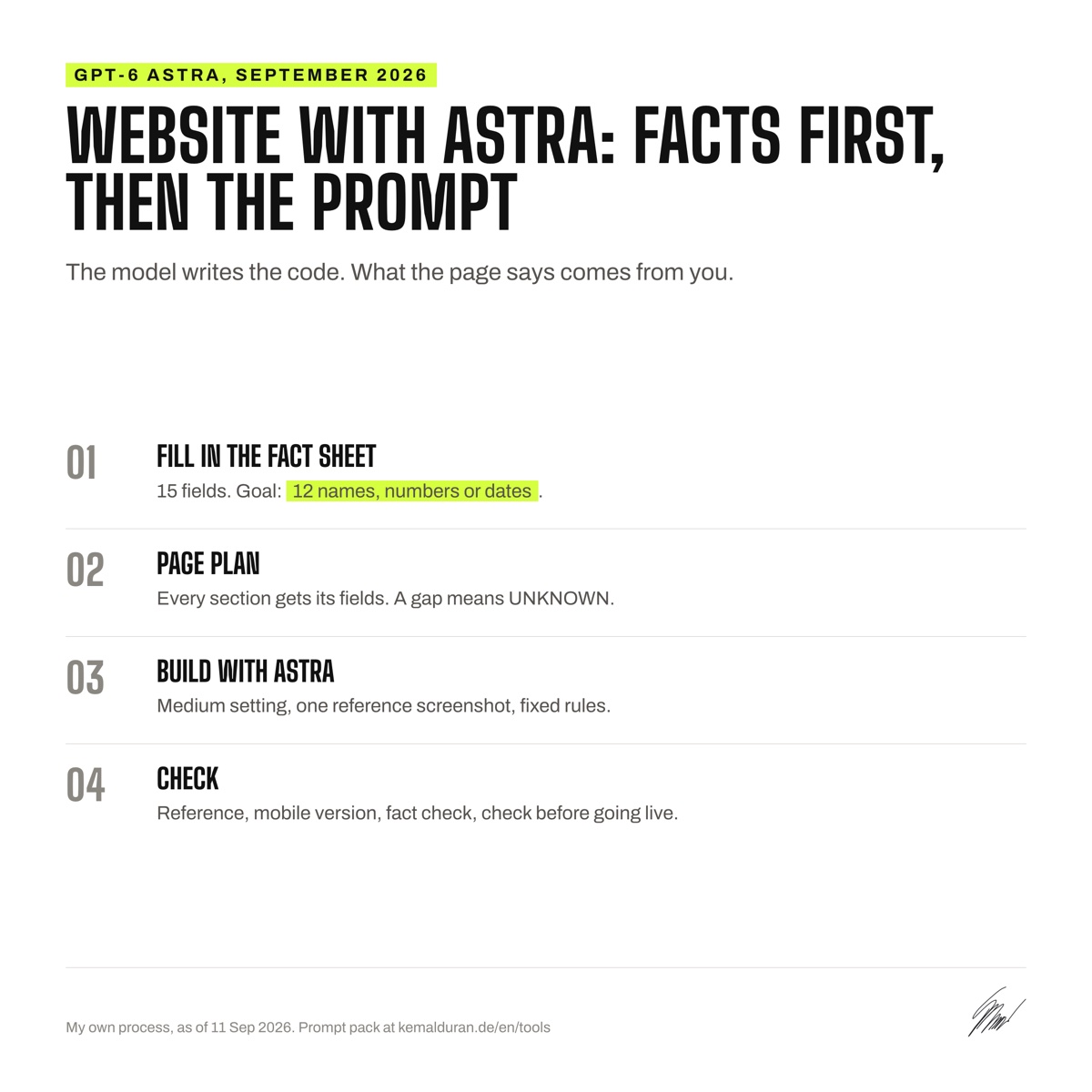
A website with GPT-6 Astra comes together in one pass if the model gets all the facts: name, services with prices, a real client job, a way to reach you and an imprint. Astra writes the HTML and CSS itself. What should be on the page, it can't know. So a fact sheet comes before the first prompt, followed by the page plan, the build and four checks.
TL;DR
- GPT-6 Astra has been rolling out since 3 Sep 2026: in ChatGPT from the Plus plan in Work and Codex, via the API as gpt-6-astra.
- The API costs $10 per million input tokens and $50 per million output tokens.
- A higher reasoning level doesn't replace missing information. Vague instructions like "modern and clean" cost rounds of fixes, and with them, quota.
- The process has seven steps: fact sheet, page plan, build with Astra, comparison with a reference, mobile version, fact check, check before launch.
What is GPT-6 Astra?
GPT-6 Astra is OpenAI's most powerful model, built for long tasks: code, research, computer control. In the API it's called gpt-6-astra. The context window holds 1,050,000 tokens, a single response up to 128,000 tokens. The knowledge cutoff is 30 Apr 2026. The reasoning level can be set anywhere from low to max.
In ChatGPT, Astra is part of Work and Codex from the Plus plan. GPT-6 Pro in chat, which also runs on Astra, is only available from the Pro plan.
Can GPT-6 Astra build a website on its own?
The code, yes. In public tests since launch, landing pages and hotel homepages came out of a single pass. In one comparison, the same homepage for a made-up hotel ran once at a low level and once at the highest. The low one took 13 minutes and 91,000 tokens, the highest took 30 minutes and 152,000 tokens. Whether the expensive version was better remained open.
The limit is somewhere else. Astra doesn't know your company. OpenAI writes in its own help pages that a higher reasoning level can't supply missing information. If a detail is missing, the model fills the gap with the usual, or it stops and asks. According to OpenAI, Astra asks follow-up questions more often than older models.
Why is "modern and clean" an expensive prompt?
The sentence contains nothing that applies only to you. From it, the model builds the page it builds for anyone who sends the same sentence. Then the fixing starts: a different color, a different hero, maybe something more serious after all.
Every round costs. On the Plus plan, OpenAI estimates 5 to 45 messages with Astra per five hours, with GPT-5.6 Sol 10 to 100. Via the API you pay for every output token, $50 per million.
The math flips when the facts are settled beforehand. Then Astra needs one pass for the build, and a cheaper model handles the rework. Why a good brief gets you further than a stronger model is also in my article on how to brief AI agents.
How does the process run from fact sheet to launch?
Seven steps, all in the same conversation.
- Fact sheet. 15 fields: name, year founded, location, services with prices, smallest project, team, one client job with a number, what you don't do, most common customer question, real customer testimonials, contact, imprint, photos, one reference site, colors. The target is at least 12 names, numbers or dates. Below that, the page becomes interchangeable.
- Page plan. Each section gets the fields it's built from. Whatever is missing is marked as UNKNOWN.
- Build with Astra. Medium level, a single reference screenshot, static HTML without a framework. Text comes only from the fact sheet.
- Comparison with the reference. Five points with actual and target values: spacing, font sizes, colors, share of images, white space.
- Mobile version. Checked at 390 and 768 pixels wide, with tap targets from 44 pixels and body text from 16 pixels.
- Fact check. Every number, every name and every price on the page has to be in the fact sheet. Anything missing there gets cut.
- Check before launch. Twelve points, from imprint and privacy through meta data and JSON-LD to the llms.txt.
Putting the plan before the build saves more rounds than any fix. The same goes for coding with agents, see Planning beats fixing.
The fact sheet and all six prompts are available as a pack at kemalduran.de/werkzeuge.
Why does the fact check come so late?
Wrong numbers stand out least when the page is finished and looks good. I saw that on one of my own sites. When I checked bruttofuchs.de on 4 Sep 2026, it turned up 31 outdated values in five guides, all labeled as current for 2026. The Minijob threshold was listed there as €538 instead of €603, the minimum wage as €12.82 instead of €13.90.
What finally found them was checking every number against my own list of values, and after that against the official source.
For an Astra page, this means: the fact sheet is the source. If the sheet stays current, so does the page.
FAQ
Do I need ChatGPT Plus for GPT-6 Astra?
Plus is enough for Work and Codex, Astra is included in the quota there. GPT-6 Pro in chat is only available from the Pro plan. Via the API, Astra runs from usage Tier 1, not on free API access.
Which reasoning level is right for a website?
Medium for the build. OpenAI writes that Astra on a low level can outperform GPT-5.6 Sol on a high level, and that a higher level doesn't always bring a better result. High only pays off once Medium fails at a specific point.
Do I need to know how to code?
No. Astra writes HTML, CSS and JavaScript itself. You need a filled-in fact sheet, a reference screenshot and, for the launch, hosting with your own domain.
Does the pre-launch check replace a legal review?
No. It checks whether an imprint, privacy policy and consent banner are in place. Whether the texts are legally sufficient is for a lawyer to decide.
M.A. Kemal Duran is Head of Digital Marketing in Cologne, leads a team and builds his own AI products such as MAMKO. He works with Claude Code, agents and his own second brain in Obsidian.
Text created with AI.