The invisible gap in the team, and why AI is closing it right now
The gap nobody names out loud
Every software team knows it.
The senior architect sits in refinement, explains a complex requirement, and twenty minutes later sees on the faces of his junior developers that half of it didn't land.
Not because the juniors are stupid.
Not because the senior explains badly.
But because between ten years of experience and two years of experience there's a gap that words alone can hardly bridge.
This gap is expensive.
It costs tickets that get rewritten three times.
It costs code reviews that are really lessons in the basics.
It costs trust, on both sides.
And until now, every team has simply accepted this gap.
What's shifting right now
I'm noticing something right now in teams that work seriously with AI-powered coding agents, not as an experiment but as a production tool.
The senior-junior gap is starting to close.
Not because the juniors suddenly have ten years of experience.
But because for the first time they're holding a tool that answers them at senior level.
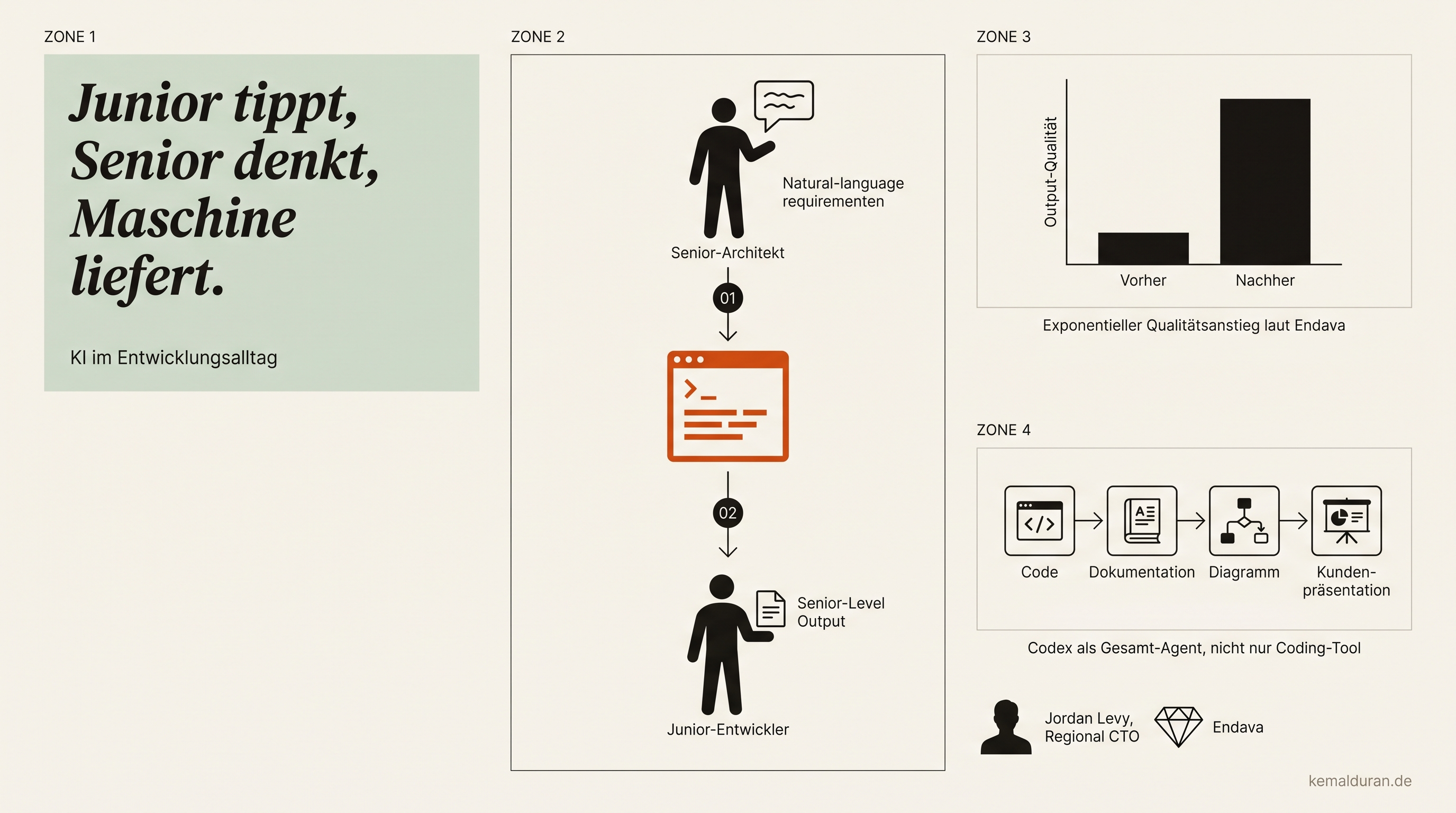
The senior architect phrases a complex requirement in natural language.
The agent translates.
The junior gets a prepared, actionable artifact, no puzzle, no interpretation, no silent hope that he'll get it right.
That sounds trivial.
It isn't.
Because the real bottleneck in most software teams was never the code.
It was knowledge transfer.
The role that's changing
If you see this only as "faster coding", you haven't seen the shift yet.
What's happening here is more structural.
The question is no longer: Who writes the code?
The question is: Who steers, who reviews, who decides?
Senior developers who get this stop spending their time producing line by line.
They start reviewing output, sharpening requirements, setting quality standards.
That's not a demotion.
That's the job they're there for in the first place.
And junior developers who get this stop waiting for explanation sessions.
They start working with an agent that meets them at eye level, patient, precise, without the implicit eye-rolling.
Output goes up.
Not gradually.
In leaps.
The example most people overlook
When most people think of AI coding tools, they think: generate code, fix bugs, write tests.
That's the smallest part.
What gets underestimated: communication.
An architect tells the agent to draw a system diagram, not for the team but for the client. So that a non-technical stakeholder understands in three minutes what three weeks of development have achieved.
Before: two hours in a presentation tool.
Today: one prompt.
That sounds like efficiency.
But it's more than that.
It's the breakup of an old hierarchy: people who could build systems couldn't always explain them. People who could explain them hadn't built them. AI is starting to close this gap, between senior and junior, and between tech and business.
What this means for Kimbo and for you
I work on technology projects, from AI platforms for the hospitality industry to smart infrastructure concepts.
What I see:
The teams that will win aren't the ones with the most developers.
They're the ones with the clearest oversight structure.
Anyone who still believes the bottleneck is production capacity, meaning hands that type, will be up against teams in two years that deliver three times as fast with a fraction of the headcount.
Anyone who starts rebuilding their workflow today so that production gets delegated and judgment gets applied is building the strongest advantage a small team can have.
The senior-junior gap was a structural problem for years.
It's on its way to becoming a solved problem.
The only question is: Which team are you on right now?
FAQ
What does the senior-junior gap mean in software development?
The senior-junior gap describes the difference in experience between seasoned and new developers, which often leads to misunderstandings about requirements. A senior developer thinks in systems and connections, a junior developer more in individual tasks. This difference often means instructions get misread and work has to be done more than once.
How does AI improve knowledge transfer in a team?
AI agents translate complex requirements from senior developers into clear, actionable artifacts for junior developers. That removes the interpretation work that used to lead to errors and follow-up questions. The junior developer gets an understandable spec right away, without having to wait for an explanation session.
Does AI change the role of senior developers?
Yes, senior developers shift their focus from pure code production toward review, quality assurance and sharpening requirements. They write less code themselves and take on more steering and review work instead. That's not a downgrade of their role. It's a return to the real core tasks of an architect.
What is the real bottleneck in software teams?
For a long time the real bottleneck wasn't how fast code gets written. It was knowledge transfer between more and less experienced developers. Complex requirements had to be explained with a lot of effort and understood correctly, which cost time and trust. AI agents shrink this bottleneck. They act as translators between experience levels.
What else can you use AI coding agents for besides writing code?
AI coding agents also work for communication tasks, for example creating system diagrams for non-technical stakeholders. An architect can tell an agent to present a complex piece of development work visually so that it's clear within a few minutes. That saves the time that building presentations by hand used to take.