Your AI stack is not a system. It's a collection of islands.
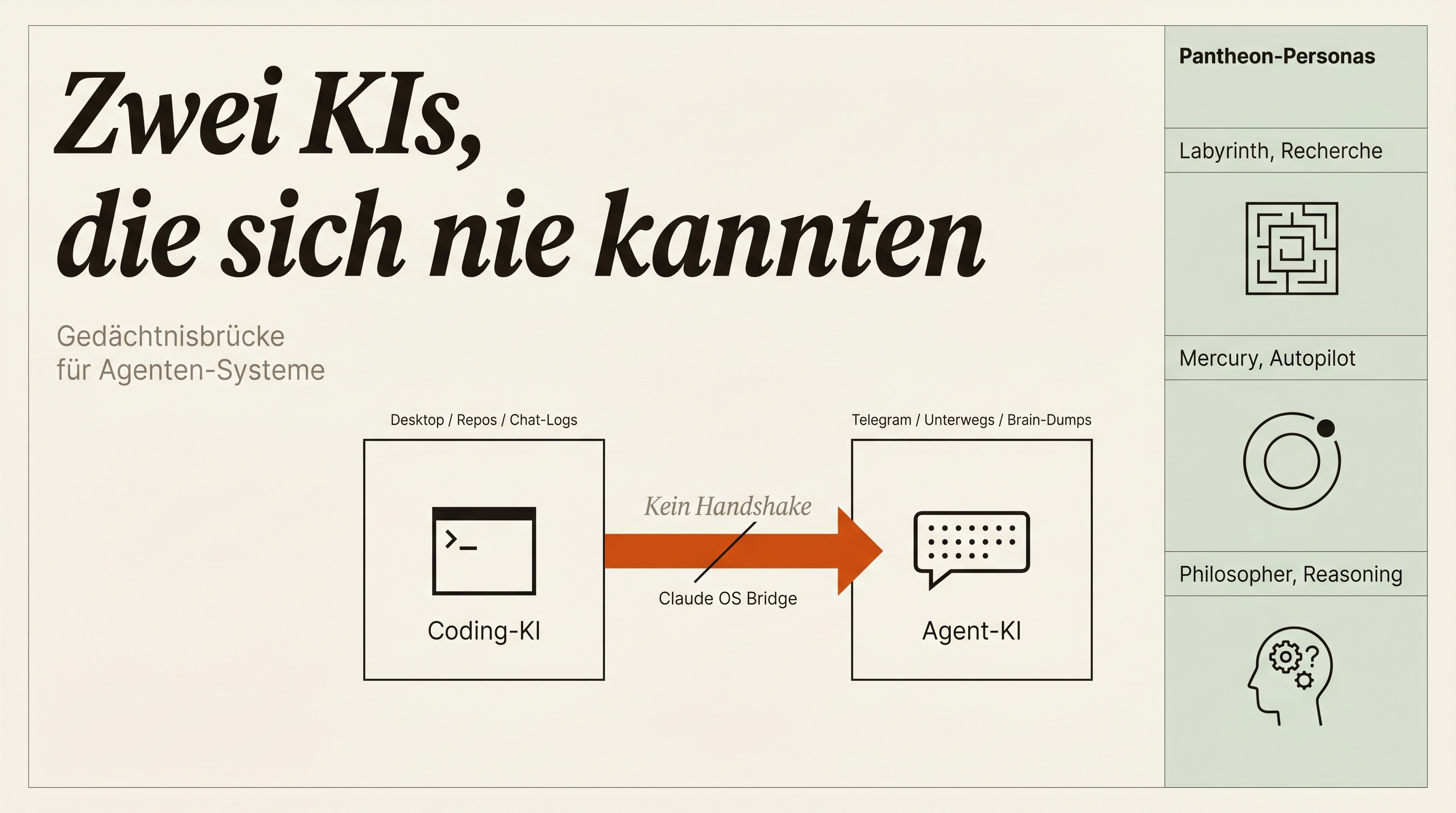
The problem has no name. So nobody pays attention to it.
You know this.
You're on the go. An idea shoots into your head. You type it into your phone, into some chat, some assistant.
Three hours later you're sitting at your desktop. Your coding tool doesn't know the context. Your notes tool doesn't know the context. You type everything in again. Again. Like last week. Like the week before.
This doesn't cost you seconds. It costs you competence.
Because every time you re-enter it, you make a silent decision: "This system is smarter than me when I feed it. But I feed it from zero again every day."
No company would wipe its best employee's memory every morning and then wonder why he works slowly.
But that's exactly what we do with our AI tools.
Two worlds. No bridge.
The classic AI stack in 2025 looks like this:
A coding agent on the desktop. It knows your repos, your bugs, your latest deployments.
An assistant agent on your phone. It knows your thoughts on the go, your voice memos, your changes of direction.
Both are good at what they do.
But they never talk to each other.
The coding agent doesn't know that this morning at the café you decided to rebuild the feature from the ground up. The mobile agent doesn't know which bugs you fixed yesterday and why the original plan no longer holds.
The result: you are the bridge. You are the data transfer. You are the shared memory.
That's not efficiency. That's a full-time job you took on without pay.
What a real AI operating system does differently
An operating system shares resources. It has memory that all processes can read. It has rules for who gets access to what.
That's the difference between a tool collection and a system.
In concrete terms, that means:
Your mobile agent automatically reads your coding agent's chat logs in the morning. It analyzes what was built yesterday, which decisions are still open, which patterns keep repeating. And at 8 a.m. it sends you two to three prioritized suggestions for improvement. Without you asking for them.
Your notes from Obsidian, your calendar blocks, your lead lists from Apollo: all visible to the same agent that prepares your email drafts in the evening.
No copying. No explaining things again. No lost context.
The system keeps thinking between your work blocks.
The Pantheon principle: specialists instead of one-size-fits-all
A mistake I see again and again, even with technically savvy people: they hand everything to one model.
Research, reasoning, autopilot crons, B2B outreach, summaries. Everything goes to the same expensive model. With the same generic system prompts.
That's as if you used the same generalist for every job in your company. He's good enough. But he isn't the best fit. And he costs the same, no matter whether the task is complex or trivial.
The Pantheon principle works differently.
For deep research: a specialized model with a system prompt tuned only for evaluating sources in a structured way. For nightly background processes: the cheapest model that does the job reliably. For complex reasoning and decisions: the strongest model, used sparingly.
Each persona has a name, a role, a matching model. Together they don't form a team of equals. They form a hierarchy of responsibility.
Costs go down. Quality goes up. Because the right task lands with the right tool.
The principle most people ignore until it's too late
If you build a system that acts in your name, prepares emails, researches leads, reads calendar entries: then the most important design decision isn't the model.
It's the question: what is it not allowed to do?
The principle of least privilege sounds dry. But it's the difference between a system that serves you and a system that does you damage you couldn't control.
Your agent may create drafts. It doesn't send emails.
It may read your calendar. It doesn't create appointments without confirmation.
It may pull lead lists. It doesn't contact anyone on its own.
Every connection gets only the permissions it needs for its specific task. No more.
That's not caution out of fear. That's system design out of clarity.
What remains when you build the system
The first morning your agent sends you a prioritized list before you've had your first coffee: not because you asked for it, but because it digested your conversations from the past week overnight.
That doesn't feel like a tool.
It feels like a context memory that finally works.
Most people will keep having five tabs open side by side. Typing in every context again. Starting from zero every Monday.
You can decide differently.
Not with more tools. With a system that thinks between the tools.
FAQ
What exactly is an AI operating system?
An AI operating system is a system that gives several AI agents a shared memory and shared access rules. Instead of every tool working in isolation, the coding agent, the mobile agent and other processes can access the same information. The difference from a plain tool collection is the shared resource, not the number of tools.
Why doesn't my coding agent know what I discussed on my phone while I was out?
Because most AI tools run as separate islands, with no shared storage. Each tool stores its context only locally, for itself. Without a connection between the systems, you have to carry the context over by hand, for example by copying it or explaining it again.
What does the Pantheon principle mean for AI agents?
The Pantheon principle means that different tasks go to different, specialized AI models instead of everything going to a single model. Research uses a different model than nightly background processes or complex reasoning. Each persona gets a name, a role and a matching model. That brings costs down and quality up.
What is the principle of least privilege for AI agents?
The principle of least privilege is a design rule under which an agent only gets the permissions it needs for its specific task. For example, an agent may create email drafts, but it may not send emails itself. The point is to limit the possible damage in case the system acts incorrectly.
Is an AI operating system only useful for developers?
No, the principle applies to anyone who works with several AI tools at the same time, whatever their job. What matters is that different systems like notes, calendar or lead lists are supposed to share the same context. If you carry information back and forth between tools every day, you benefit from a shared memory.