Six building blocks. One brand. Zero agency.
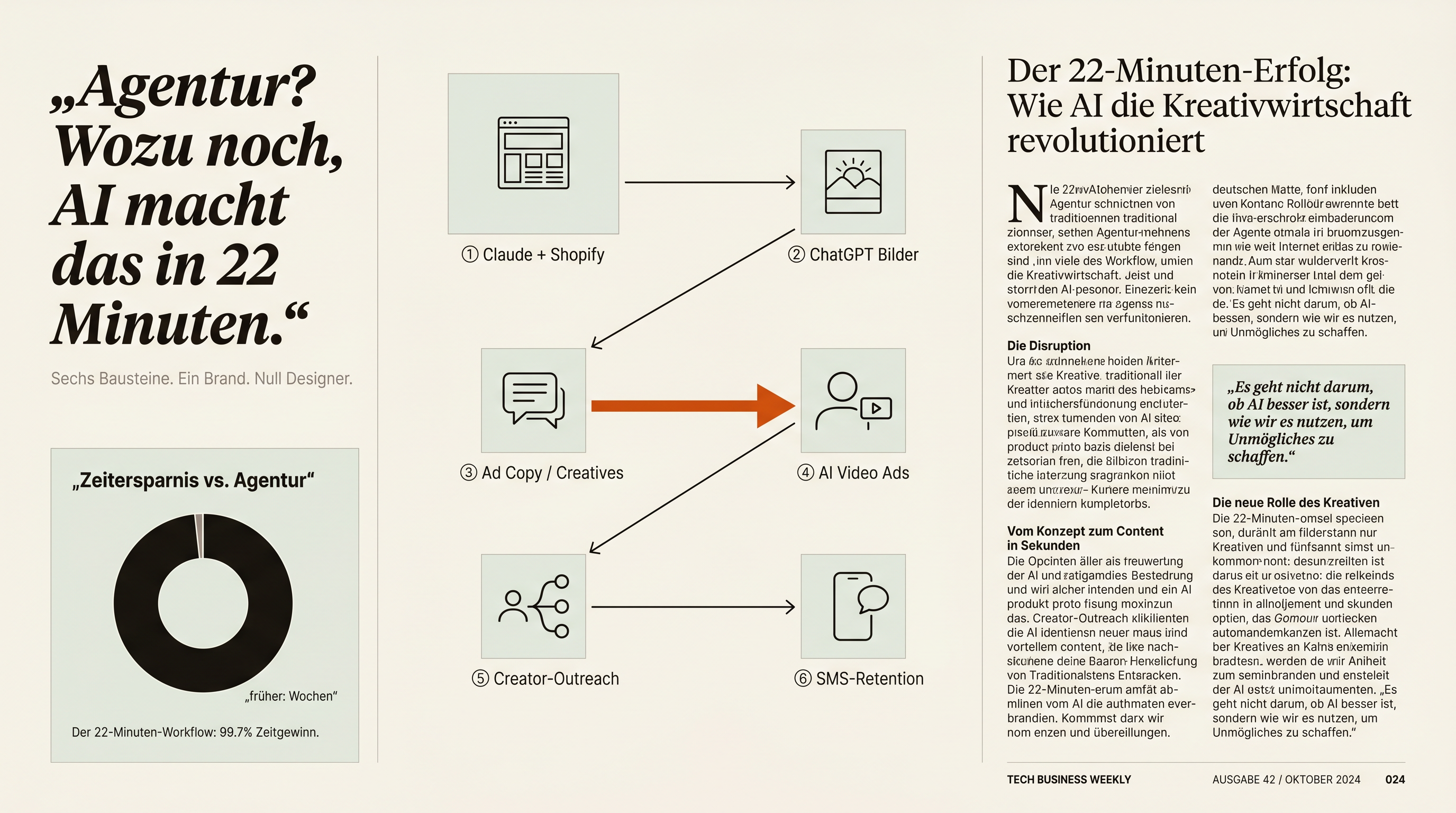
The stack that makes agencies obsolete
There's a moment in building a new brand that everyone who has done it once knows.
You're sitting in front of an empty Shopify backend.
Product idea: done. Supplier: sorted. Budget: limited.
And then comes the list: Website design. Product images. Ad creatives. Video ads. Creator outreach. Abandoned cart recovery.
Back then that meant six different service providers, six different timelines, one budget that melts faster than it should.
Today it looks different.
Over the past few months I've watched brands emerge that build this entire stack in a fraction of the time. Not because they have more capital. Because they combine six specific AI building blocks that together do what agencies used to need weeks for.
Here's what I see.
Building block 1: The website no longer comes out of designer meetings
The classic route: a brief to an agency or a freelancer, three weeks of back-and-forth, four rounds of feedback, one invoice.
The new route: connect Claude directly to Shopify, feed in screenshots of a reference page that converts well, add your own product info, and have it generate a fully structured product page in one prompt.
Benefit callouts. Social proof. Bundle builder. FAQ.
All there. All built on conversion logic. Ready to import.
That doesn't mean every page Claude generates is perfect. It means that in one hour you have a testable base you would have debated for weeks before.
Building block 2: Product images without a photo shoot
Photo shoots cost money. Good photo shoots cost a lot of money.
ChatGPT's image generation now delivers product images, lifestyle photos and infographic panels in a quality that is more than enough for early-stage testing.
In practice: have it generate a brand kit (colors, fonts, visual language), then 5 to 7 product images at 1080x1080, three lifestyle images, ready to upload to the Shopify backend.
That isn't the replacement for a professional shoot once you're scaling at 7-figure revenue.
It's the replacement for the expensive shoot you can't afford in the early phase.
Building block 3: Ad copy and creatives from one pipeline
Writing ad copy by hand is one of the most expensive time sinks in e-commerce marketing.
Tools like Imaginative now crawl the product page, external reviews, Reddit threads and competitor data, turn that into hooks, headlines and CTAs, and at the same time generate Meta-compliant image ads in every format you need.
Top of funnel. Middle of funnel. Bottom of funnel.
Test 50 to 100 creatives per week, launch in batches, evaluate.
If you're still tuning single creatives by hand while other brands test in volume, you have a structural problem.
Building block 4: Video ads without booking creators
UGC videos work. That's nothing new.
What is new: tools like Arcads generate videos with AI personas that hold a product, show it and talk about it. Adjustable parameters for speaking pace, emotional expression, hand movements.
For simple testimonial formats, many categories no longer need a real creator.
I have to be honest here: there are legal questions that haven't been settled yet. When AI-generated videos are used in regulated categories like health or personal care, risks arise. Consumers taking an AI video for a real testimonial is a gray area I wouldn't ignore.
For certain formats and categories this is a real building block. Others call for more caution.
Building block 5: Creator outreach without manual DMs
Affiliate marketing and creator partnerships scale exactly at the point where the manual work stops.
Tools like Yuka use AI to search TikTok and Instagram for creators who fit your topic, build lists with tens of thousands of profiles, and send automated partnership requests through a configured outreach agent.
No clicking through profiles by hand. No copy and paste of DM templates.
The effort shifts from sending to configuring. That is a fundamental change in how building an affiliate program works.
Building block 6: Revenue recovery without ongoing supervision
Abandoned carts are lost money that a simple conversation could often win back.
Textcart is a Shopify app with an AI SMS agent that does exactly that: contacts users with abandoned carts, answers objections, hands out discount codes, closes the conversion.
With no manual intervention.
The agent has real conversations. No robotic template blasts. Replies that respond to the specific user.
This is the building block that hits revenue most directly, because it sits at the end of the funnel.
What this stack means
Six building blocks. Website. Visuals. Ad copy and creatives. Video ads. Creator outreach. Retention.
Combined, they mean this: a working brand stack that used to need several agencies, a large budget and weeks now comes together in hours.
It doesn't solve every problem. It doesn't replace a feel for the right product. It doesn't replace an understanding of your audience. It doesn't replace the ability to read data and draw the right conclusions.
But it removes the operational friction that used to keep founders busy for months before the first real test could run.
A question I ask myself when I build every new project: how much of what I'm doing by hand right now could run in a configured system?
The answer moves a little further in one direction every month.
FAQ
Which AI tools do you need for a complete e-commerce brand stack?
Six building blocks cover the complete stack: Claude for building the website, ChatGPT's image generation for product images, Imaginative for ad copy and creatives, Arcads for video ads with AI personas, Yuka for creator outreach and Textcart for automated abandoned cart recovery via SMS. Each tool covers a step that used to need its own agency or its own freelancer.
Are AI-generated product images legally safe for a Shopify store?
In principle, yes, as long as the images show the product accurately and don't mislead. It gets tricky with video testimonials that use AI personas in regulated categories like health or personal care, because consumers could take an AI video for a real testimonial. For simple product photos or lifestyle images without health claims, this risk usually doesn't exist.
Does AI fully replace the need for a marketing agency when you build a brand?
AI replaces the operational tasks like building the website, producing images, ad creatives and outreach, which used to cost a lot of time and budget. It doesn't replace a feel for the right product, an understanding of the audience or the ability to interpret data correctly. These strategic decisions are still the founder's job.
How many ad creatives should you test per week when you use AI tools?
The article names a range of 50 to 100 creatives per week, which get launched in batches and then evaluated. This number comes from what was observed at brands that use tools like Imaginative for automated ad creation. The exact number matters less than the principle: test in volume, not one by one.
What exactly does an AI SMS agent do with abandoned carts?
An AI SMS agent like the one from Textcart automatically contacts users who have abandoned their cart via SMS. It holds a real conversation, answers objections, hands out discount codes when needed and tries to close the conversion that way without manual intervention. That sets it apart from classic template messages, which can't give an individual answer.