Your AI setup has a memory problem. Here's the architecture that fixes it.
The problem has a name: context amnesia
You have a good conversation with your AI assistant on your phone.
On the go, in a taxi, between two meetings.
Ideas come up. Directions become clear.
Then in the evening you sit down at your laptop.
New chat. Blank page.
The AI doesn't know what happened this morning.
You start over.
That's not your fault. It's an architecture problem.
Most AI setups are silos. Mobile here, desktop there. No shared context, no persistent memory, no connection.
The outcome: you carry the context in your head.
The AI does the work, you do the remembering.
That's backwards.
What an Agentic OS means in real terms
An Agentic Operating System is not an app.
It's an architecture philosophy.
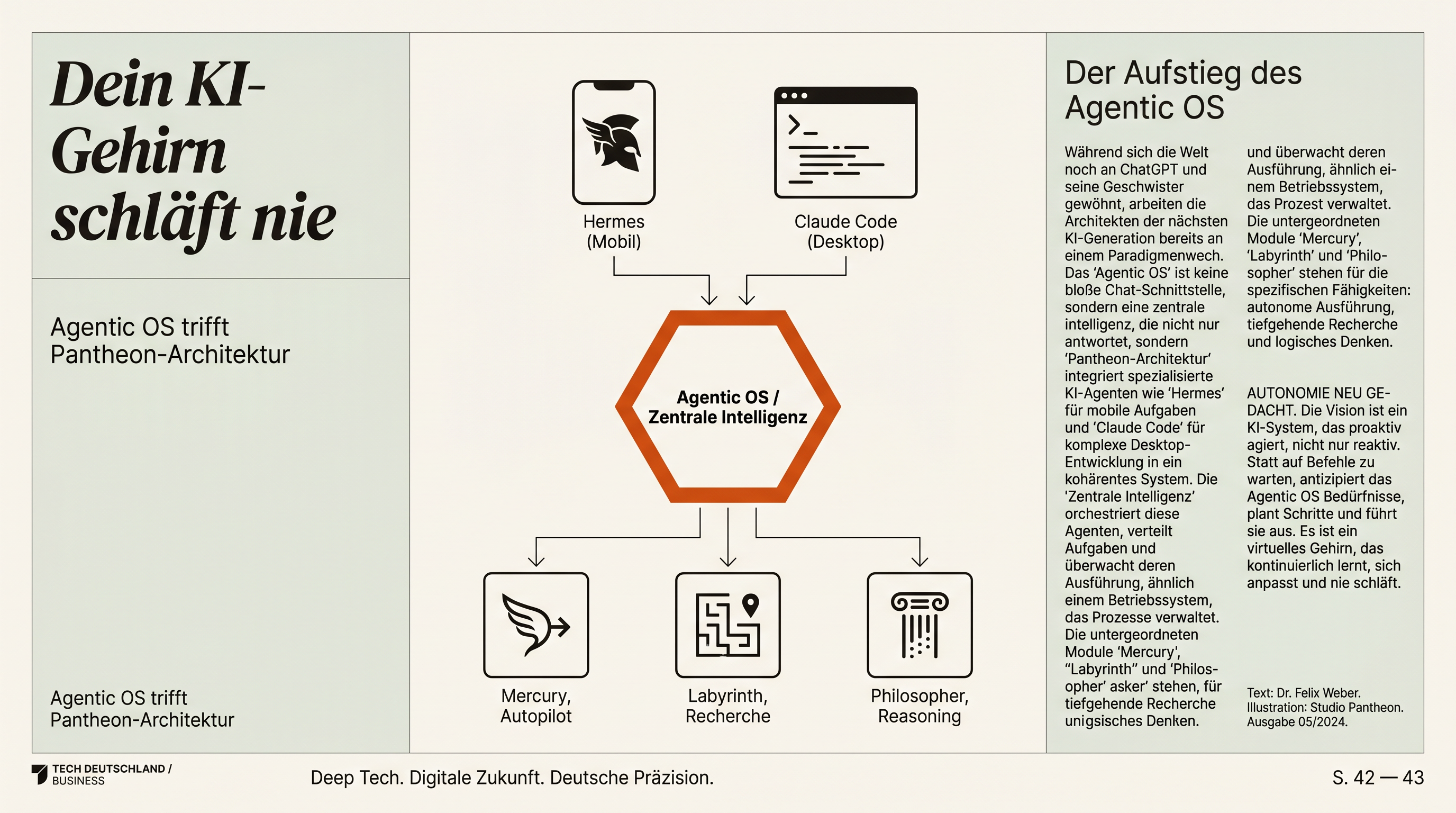
The core idea: one central intelligence layer connects all your AI tools, all your workflows, all your conversations through a shared foundation.
Mobile and desktop are no longer treated separately.
They feed into the same system.
The context travels with you.
In practice, this means: when you start a research task with your AI assistant on your phone in the morning, your desktop agent knows about it in the evening.
No copy and paste.
No manual transfer.
The thread stays intact.
Why a generalist agent isn't enough
The architecture everyone reaches for first, by instinct, is always: one agent for everything.
That sounds simple. It is. Too simple.
A generalist does everything at a mediocre level.
Research, deep reasoning, operational delegation: these are entirely different tasks. They need different ways of thinking, different configurations, different priorities.
The stronger architecture: specialized sub-agents, trained specifically for their task and configured for it.
A research agent that only collects information, filters it, prioritizes it.
A reasoning agent that thinks slowly, uncovers contradictions, forms hypotheses.
An autopilot agent that delegates, coordinates, executes.
The central agent, in this case Hermes, takes on the role of dispatcher.
It decides who gets which task.
It's the conductor, not the soloist.
Obsidian as the long-term brain
Every system without persistent storage has Alzheimer's.
The answer I keep iterating on in my setups, for myself and for my clients: Obsidian as the central vault.
Obsidian is a local knowledge management tool.
It stores notes as Markdown files on your device.
No cloud dependency if you don't want one. Full control.
When you connect this vault to your agent system, something interesting happens:
Every conversation gets saved.
Every decision gets documented.
The system can access everything you have ever discussed with your AI.
And the strongest part of it isn't the search.
It's what happens while you sleep.
The overnight loop: your system thinks while you sleep
What if your AI system worked through the day's entire chat history in the evening and was waiting for you early in the morning with concrete suggestions?
No active input from you.
No prompt at midnight.
The system analyzes, condenses, prioritizes, and has the results ready for the next morning.
That's not a science fiction feature.
It's a configuration decision.
You define an asynchronous reasoning loop.
The agent runs through the data at night.
You start the next day with a briefing your system put together for you.
For business owners who run several projects in parallel, this isn't a nice-to-have.
It's a structural advantage.
The everything dashboard as a philosophy
Most people use five AI tools.
In five different tabs.
With five different contexts.
And wonder why it doesn't feel like a system.
The right answer isn't: fewer tools.
The right answer is: one central interface that integrates all the tools.
A dashboard that shows you what your agents did today.
What they suggest tonight.
Which models you used, and how.
Which tasks are still open.
You steer.
The agents work.
The system remembers.
That's the architecture I'm working toward.
For my own projects, from CUVIR to Mamko, and for the setups I build for clients.
What this means for you
If you take AI seriously, ask yourself three questions:
Where does your context live when you close the tab?
Who takes over what while you sleep?
Do you have a system or a collection of tools?
Most people can't give a clear answer to all three questions.
That's the gap.
And the gap has an architectural fix.
An Agentic OS isn't future technology.
The building blocks exist today: local storage like Obsidian, specialized agent frameworks, models like Claude Code and Hermes, API connections.
What's missing is the design.
The decision about how these parts work together.
That's the work.
And it pays off.
FAQ
What exactly is an Agentic OS?
An Agentic OS isn't a single app. It's an architecture that connects several AI agents and storage locations through a shared foundation. The context moves with you between devices like your phone and your laptop, instead of staying trapped in individual chats. A central dispatcher agent hands out tasks to specialized sub-agents. The architecture turns separate tools into one connected system.
Why isn't a single AI agent enough for everything?
A single generalist agent has to cover research, deep reasoning and operational delegation at the same time. These are different tasks with different demands on thinking and configuration. That's why an agent that does everything does everything only at a mediocre level. Specialized sub-agents, each configured for one specific task, deliver better results.
What is Obsidian used for in this setup?
Obsidian is a local knowledge management tool that stores notes as Markdown files right on your own device. In this setup it is the central vault and works as the long-term memory of the AI system. Every conversation and every decision gets documented there and stays retrievable. That gives you persistent storage without necessarily needing a cloud connection.
What does the overnight loop do in concrete terms?
The overnight loop is an asynchronous reasoning process that runs at night without active input. The agent works through the day's chat history and data, condenses it and prioritizes it. The next morning, a finished briefing with concrete suggestions is waiting. It's a configuration decision, not a separate product.
What role does Hermes play in this setup?
In the setup described here, Hermes takes on the role of the central dispatcher. It decides which sub-agent gets a task for research, reasoning or operational execution. Hermes does no deep specialist work itself. It coordinates the specialized agents. That makes it comparable to a conductor who directs how everyone plays together instead of playing along.