When the agent takes over as director
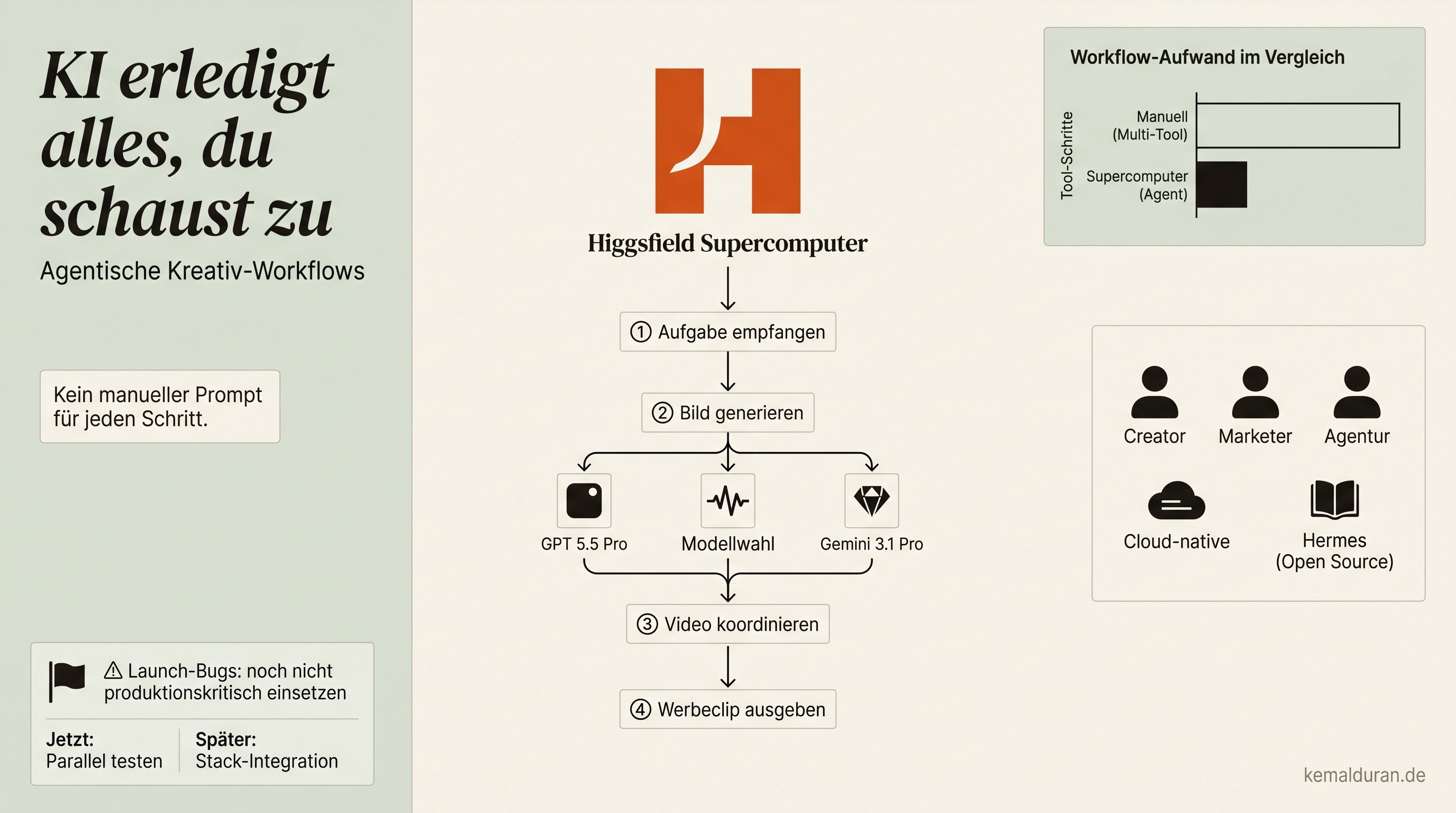
The moment you stop being the coordinator
You know that moment in the kitchen when the sous-chef starts handing out tasks on his own?
You explained to him once what the mise en place should look like.
He nods.
And at the next service, everything runs before you say a word.
That exact feeling describes what's happening right now with agentic AI platforms.
No more: prompt for image. Download image. Prompt for video. Export video. Glue it all together.
Instead: one task. One goal. The agent does the rest.
Higgsfield recently launched Supercomputer, and that's exactly what it's trying to do.
What Supercomputer is, exactly
The platform is not a generation tool.
That's the difference that matters, and most people miss it at first glance.
It's not about generating a better image or rendering a nicer clip.
It's about automating the entire workflow.
Image out.
Video out.
UGC-style product ads out.
Without you jumping back and forth between three browser tabs and kicking off every step in between by hand.
Under the hood, Supercomputer is built on Hermes, an open-source agent framework. Higgsfield extended Hermes with its own image and video models and built in its own prompting logic, designed specifically for creative AI models.
The result: an agent that handles more than a single task. It coordinates a whole chain of tasks on its own.
Which model does the thinking here
A detail that matters for output quality, and one you should understand before you test:
Supercomputer lets you choose which language model works as the agent's "brain".
GPT 5.5 Pro, Sonnet, Opus 4.6, Gemini 3.1 Pro, depending on the plan, depending on the task.
That's not a cosmetic feature.
The choice of language model affects how the agent reads your task, how it plans the steps in between, and how cleanly the end result gets coordinated.
For more complex ads, for example a UGC clip with several scenes, a clearly defined product and a specific visual style, it pays to work with the strongest model available.
For simpler image generation, a leaner option is enough.
Test. Compare. Decide.
The honest state of things
Now comes the part many tool reviews leave out.
Supercomputer is new. Brand new.
And you can tell.
Some workflows run through cleanly. The agent takes over, coordinates, delivers.
Other workflows stumble. Bugs. Inconsistency. Outputs that miss what you described.
If you plug the tool into your production-critical stack now and expect the agent to produce five ads for a restaurant client on its own by tomorrow morning, you'll be disappointed.
If you test it on the side, next to your existing tools, with low stakes and high curiosity, you're learning something important right now:
What agentic creative workflows will look like in six months.
What this means for your stack
There's a rule I apply to every new tool I build into our projects:
First observe, then test, then scale.
Never all three at once.
Higgsfield Supercomputer is in phase two right now.
Testing. Watching what runs cleanly. Noting what still breaks.
The concrete use case where the tool is already relevant: UGC-style product ads. Short clips, a clear product, a standardized format. That's exactly where Supercomputer shows what agentic automation can do when the task is clearly defined.
If you supply restaurants, retail brands or service businesses with content, you should start experimenting now.
Not because the tool is finished.
Because in three months you'll be glad you know how it works.
The real shift
Agentic platforms don't change what gets produced.
They change who coordinates.
Until now, that was you: you opened the image tool, judged the result, loaded it into the video tool, wrote the prompt, exported, put it all together.
Soon it's an agent: you set the goal. It coordinates.
Your job shifts.
From the one who executes to the one who briefs.
From coordinator to director, the one who describes the scene and then waits for the clapperboard to snap shut.
That's no small difference.
That's a different relationship with work.
And if you get this early, two years from now you won't have to wonder why others produce three times faster.
FAQ
What exactly is Higgsfield Supercomputer?
Supercomputer is an agentic AI platform from Higgsfield that automates creative workflows. Instead of entering separate prompts for image and video, you set a goal and the agent coordinates the individual steps itself. Technically, the platform is built on the open-source framework Hermes, which Higgsfield extended with its own image and video models.
Which language model should I choose in Supercomputer?
That depends on how complex your task is. For simple image generation, a leaner model option is enough. For more complex ads with several scenes and a clear visual style, the strongest available model pays off, because it plans and coordinates the steps in between more precisely.
Is Higgsfield Supercomputer reliable enough for production work yet?
No, not across the board. Some workflows already run cleanly, others still show bugs and inconsistent outputs. If you build the tool into production-critical processes now and expect full autonomy, you'll be disappointed for the time being.
What is an agentic framework like Hermes?
An agentic framework is a software structure that lets an AI agent plan and carry out several task steps on its own, instead of only reacting to single prompts. Hermes is an open-source example of this. Higgsfield extended it for Supercomputer with its own prompting logic for creative tasks.
Which use cases is Supercomputer best suited for right now?
Right now the platform is most relevant for UGC-style product ads, meaning short clips with a clear product and a standardized format. With clearly defined tasks like these, the agent shows what automated coordination can already do.