Luigi Colani: what it costs to be right forty years too early
A video by @8erko pulled me into a topic this week that I haven't been able to shake since. It's about Luigi Colani, and about the question of what it costs to be right too early.
Who was the man in the white suit
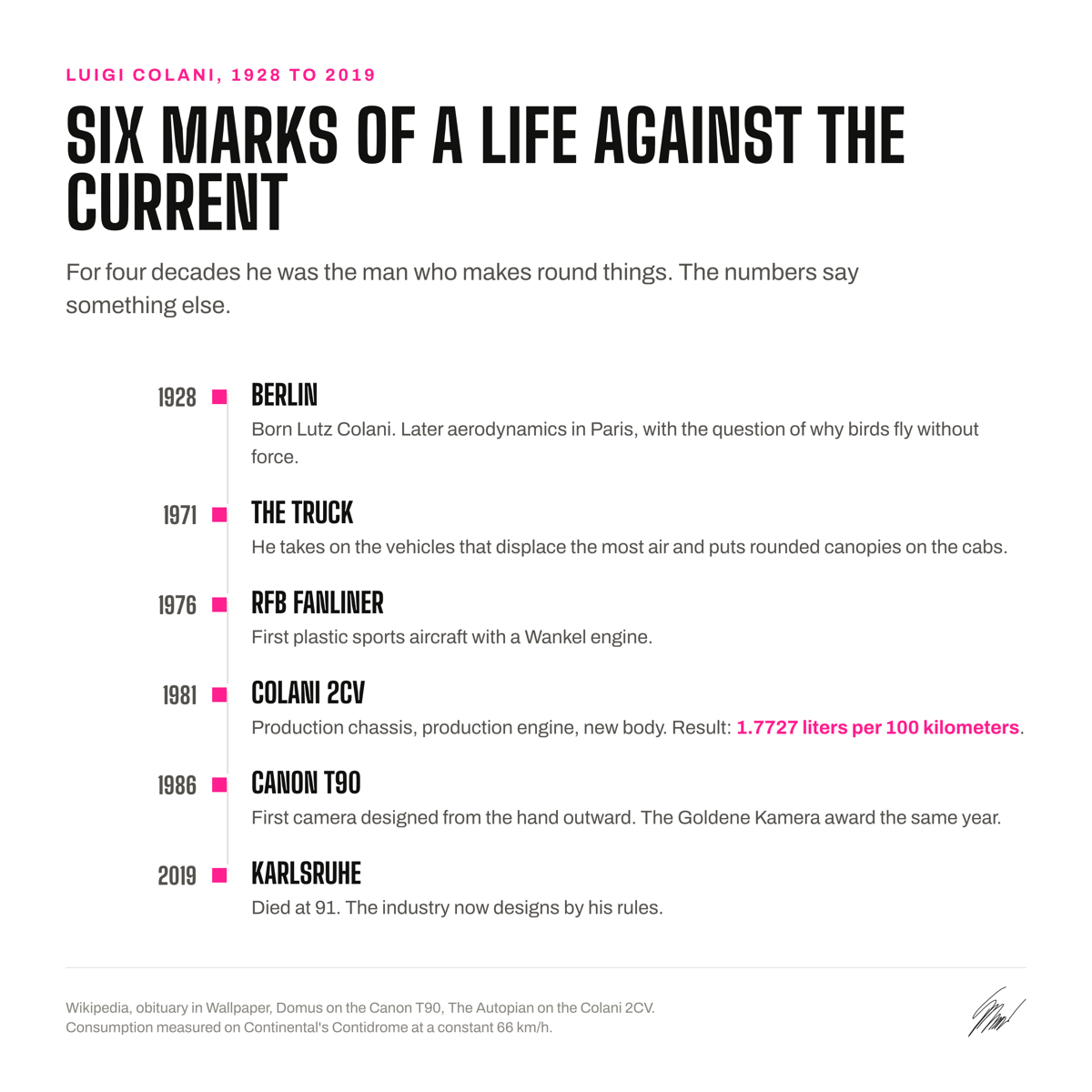
Born in 1928 in Berlin as Lutz Colani, died on 16 September 2019 in Karlsruhe, 91 years old. In between: aerodynamics studies in Paris in the late forties, where he worked on the question of why birds can fly and airplanes need force to do it. After that, car bodies for Fiat, Alfa Romeo, Lancia, VW and BMW. From 1971, trucks, because it bothered him that a truck gets pushed through the air like a wardrobe. In 1976 the RFB Fanliner, the first plastic sports aircraft with a Wankel engine. In 1982 he moves to Japan and teaches in Tokyo. For around two decades he works as a design consultant for NASA.
Even so, in Germany he was long seen as the man who makes round things.
The proof nobody could argue away
In 1981 Colani takes a production chassis of a Citroën 2CV, leaves the engine and mechanics untouched and builds his own body around it. Airfoil profile, tiny frontal area, hardly any add-on parts, a Kamm tail at the rear. Plus Goodyear tires with low rolling resistance.
On Continental's Contidrome, this car does 1.7727 liters per 100 kilometers, at a constant 66 km/h.
The figure is a measurement at a steady speed, not everyday consumption, and that is exactly how it should be read. The result stays uncomfortable all the same: without a single new engine, through the shape alone, consumption dropped to a fraction. 1981. In a decade when the industry still took aerodynamics for cosmetics.
The camera that knows your hand
In 1986 the Canon T90 comes out, designed by Colani. It is the first camera that was thought out from the grip and not from the body. Instead of metal and hard plastic he goes with polycarbonate, because it lets you build flowing shapes. Colani later said it took him two years to make Canon understand that a camera sits between a human hand and a human eye and therefore needs ergonomics on both sides.
The same year, the T90 gets the Goldene Kamera. Critics at the time called it a plastic thing anyway. Today every Canon SLR carries this legacy in its body, and the same way of thinking is in your mouse, your controller and your phone.
Learning from nature doesn't mean drawing a copy of it
This is the point where most people misunderstand Colani, even the ones who like him. His cars looked like dolphins and his airplanes like birds, but the resemblance was never the goal. It was the result. A body that has been moving through a medium for millions of years has long since solved the problem an engineer is working on right now. Anyone who takes that seriously doesn't copy a shape but adopts a solution.
That's why the 2CV from 1981 is not an art object. It's a piece of evidence.
The rule he broke
There's a phrase almost every industrial designer knows. Raymond Loewy called it MAYA: Most Advanced Yet Acceptable. Be as far ahead as people can just about stand. No further.
Colani struck out the second part.
That's the whole conflict in one sentence. He was right on the facts and lost anyway, for decades, because he left out the translation. Anyone who no longer understands talks it down. In German arts pages, biodesign turned into the accusation that it was all just round.
What I take from it
Two things, and neither has anything to do with cars.
First, the brand. Dieter Rams was Braun. Colani was Colani. White suit, cigar, his own name on every design, decades before anyone ever said the words personal branding. He understood that a designer who is only visible for companies disappears with the company. That lesson is worth more today than it was back then, because by now it applies to almost every profession.
Second, the acceptance question. For a long time I thought MAYA was cowardice. After this video I think it's timing. The difference between an idea that works and one that people smirk at rarely lies in the idea. It lies in whether someone builds the bridge that others can cross. Colani didn't build the bridge. The industry got to where he was anyway at some point, just forty years later and without him.
For your own work, this means: radical in substance, clear in the handover. Both together are the work. One of them alone is either boring or lonely.
Sources
The spark came from the video by @8erko on TikTok. I looked up the figures and data myself afterward:
Text and images were created with AI. The photo is a mood image, not evidence of a specific event.