The image as the first sentence
The old story
I still remember the first time I saw an AI-generated image.
Blurry hands. Six fingers. Text in the image that looked like a stroke in Helvetica.
Nice for Twitter jokes. Useless for anything that counts.
We learned to lower our expectations. Image generation was the feature that was always "almost good". Almost photorealistic. Almost readable. Almost what you meant.
Almost is not a product.
What is shifting right now
ImageGen 2.0 is not an update.
It's the moment "almost" turns into a real tool.
Three jumps make the difference, and none of them is a small step:
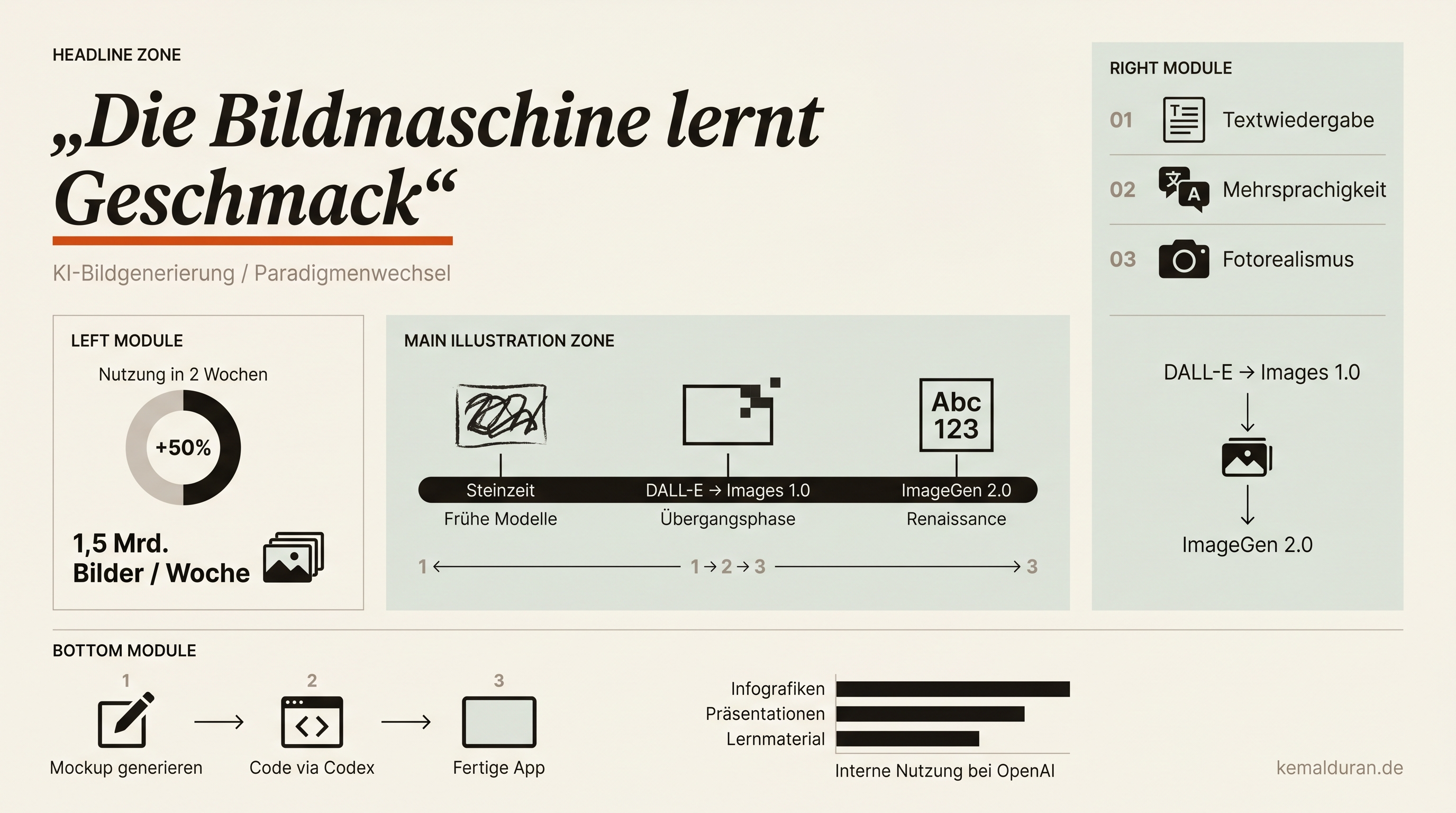
First: Text in images works now.
That sounds trivial. It isn't. Every time I used to need an infographic, a poster, a study page, the AI-generated draft was only a first step, then came Canva, then came rework, then came frustration.
If you enter a complex biology diagram prompt today and get graduate-level correctness as feedback, from a subject professor, not from an influencer, you're watching live as a category scales.
Second: Photorealism that no longer needs explaining.
There's an internal test: Can you tell the generated image apart from a real photo? The answer used to be: mostly yes. Today: not always.
Third: The model has learned taste.
Not as a metaphor. As a trainable property. A professional consulting deck looks different from a children's book illustration. An architecture rendering looks different from a mood board. The model knows that, and delivers accordingly.
The workflow going viral right now
Mockup in.
Code out.
That's the sentence behind the workflow hundreds of builders are discovering right now: Generate an image in ImageGen, hand the image to Codex, get working code back.
Website concept in twenty minutes. App interface without a designer briefing. Game character as a sprite sheet, fed back in, consistent variations for every scene.
This is not a future scenario.
It's happening right now.
For CUVIR and for everyone who produces creative assets: The bottleneck is no longer skill. The bottleneck is the speed between idea and first draft. That bottleneck has gotten smaller.
Much smaller.
What users really want
This is where it gets interesting, and it says more about us than about the model:
The viral trends aren't heading toward perfection.
Microsoft Paint style. Crayon. Scribble. Deliberately raw, deliberately imperfect, deliberately human.
It takes real intelligence to make something look bad on purpose. The model can do that. And users want it.
Why?
Because authenticity is the only thing that doesn't scale. Perfection has gotten cheap. An aesthetic signature style hasn't.
For every creative project, that means: The question is no longer "How good can the image get?" The question is: "How recognizable is the signature style behind it?"
KIMBO has a sound world. CUVIR has a visual language. Mamko has a product logic.
Tools are getting better. The identity behind them is getting more important, not less.
Three things I'm doing differently right away
First: Style as an anchor, not as decoration.
"Minimalist", "children's book style", "professional consulting deck": a clear aesthetic anchor at the start of the prompt saves three rounds of iteration at the end.
Second: Upload a reference image instead of spelling everything out.
The model picks up the spirit of an image better than I can describe it in text. A mood board screenshot says more than two hundred words of description.
Third: Use Thinking mode when it gets complex.
When composition, context and details all have to be right at the same time, switch Thinking mode on. The model thinks longer, researches on its own, delivers more precisely.
Most people use the tool in standard mode and wonder why the result has standard mode quality.
The next step
The direction is clear.
A model that knows your preferences. That knows how your brand sounds and looks. That doesn't need a style brief, because it already has your style.
That isn't fully here yet.
But the building blocks are already on the table.
Anyone who learns today how to feed the tools properly, with references, with style anchors, with clear aesthetic parameters, is training more than a model right now.
They are training their own way of working for what comes next.
For a long time, the image was the last step in the creative process.
It's becoming the first.
FAQ
What exactly is ImageGen 2.0?
ImageGen 2.0 is an AI model for image generation with much better photorealism, correct text rendering in images and a trained sense of style. What sets it apart from earlier versions: results are usable right away, without many rounds of fixes. That makes it less of a toy and more of a work tool for creative professionals.
Can ImageGen 2.0 now generate readable text in images?
Yes, that's one of the central advances over older models. In the past, text in images often looked distorted or unreadable. Now it works reliably, even in more complex uses like diagrams or posters. That makes infographics and learning materials usable right away, without a detour through tools like Canva.
What does the mockup in, code out workflow mean?
It means you create an image or a draft in ImageGen and then hand that image to a code model like Codex. The code model turns it into working code, for example for a website or an app interface. This workflow cuts the time between idea and first working draft by a wide margin.
When should I use Thinking mode in ImageGen?
Thinking mode is worth it when an image has to meet several requirements at once, such as a specific composition, the context of the content and fine details. The model then takes more time and does its own research before it generates the image. In standard mode, the result often turns out less precise.
Why do many current AI images look imperfect on purpose?
That's because many users now deliberately choose raw styles like scribble or a crayon look instead of maximum photorealism. Better models have made perfection easy to get, while a recognizable, imperfect signature style is rarer and therefore worth more. That's why many people go for authenticity instead of technical perfection.