People who already pay don't need convincing
The filter most people miss
Cold outreach has a basic problem.
You don't know whether the person on the other end wants to spend money at all.
You don't know whether marketing is a priority for them. You don't know whether they're ready to decide today or in three years.
You're guessing.
And most of the systems I've looked at are built on exactly this guessing. LinkedIn scrapers, Apollo exports, email lists filtered by industry and headcount. Clean data. Bad filter.
Because there's one thing company size and industry don't tell you: is this person actively spending money on advertising right now?
The Facebook Ads Library tells you.
Anyone who shows up there has a running campaign. Has approved a budget. Has decided: yes, we're investing in visibility now. That's not a prospect. That's a buyer. Just not yours, not yet.
That difference is the core of the system I'm about to show you.
What the system does while you sleep
Every morning at 8 a.m., an automated process runs.
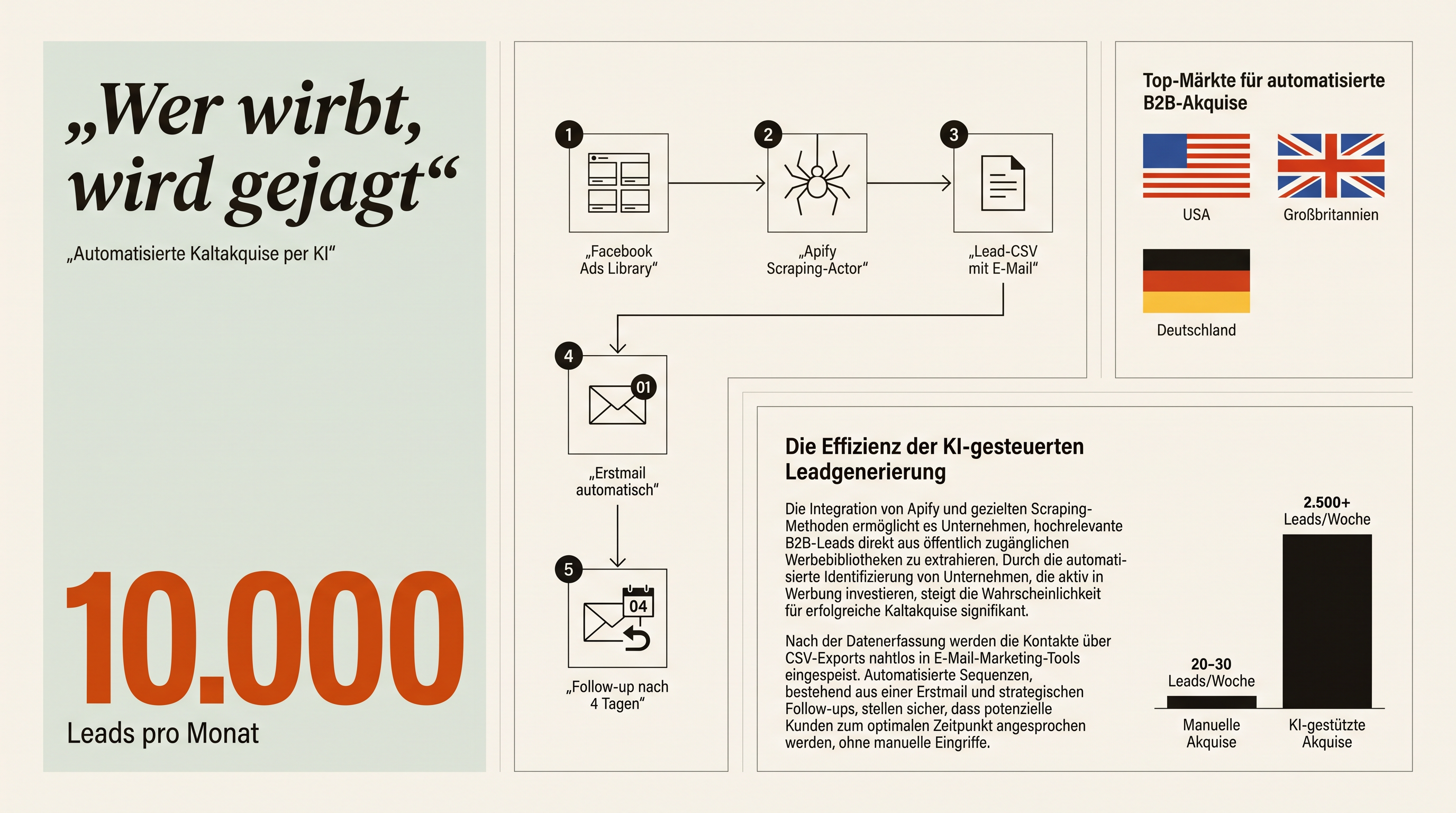
It opens the Facebook Ads Library, searches for your defined keywords, e.g. "webinar", "coaching program", "online course", "book a consultation", extracts the contact details of the companies currently running ads and saves them in a CSV file.
Then the system checks which of these contacts haven't received an email yet. It sends personalized first-contact emails. Not as a mass mailing in your name, but with your offer, your language, your value proposition.
Four days later: anyone who hasn't replied gets a follow-up. Anyone who has replied is taken out of the queue.
In the morning you open a dashboard in your browser. See leads scraped, emails sent, reply rate, open follow-ups.
No manual intervention after the setup.
The technology behind it: Claude Desktop as the central control system, Apify as the scraping layer, your email account as the sender. Three components. One daily routine.
Why the quality filter makes the difference
Let me tell you what I see again and again.
Agencies build huge lists. Thousands of contacts. Send the same text to everyone. Wonder about a 0.3% reply rate and blame the channel.
The problem isn't the channel.
The problem is that 90% of the list had no intent to buy.
When you use the Facebook Ads Library as your filter, you cut down that scatter. You know: this person is spending money on advertising today. Your offer, if it fits the context, doesn't land somewhere vague. It lands in an active decision window.
That changes the logic of the conversation.
You don't ask: "Can I explain to you why marketing matters?" You say: "I see you're running campaigns right now. Here's what we did better for similar companies in your segment."
A completely different conversation.
The setup in practice
Claude Desktop, paid plan, create a new project.
The project instructions are the heart of it. You enter: your name, your email address, the keywords the system should search for, the country code for the Ads Library, and your offer in two to three sentences with a concrete benefit.
Then you connect Apify through the connector in Claude Desktop. Apify offers a dedicated Actor for the Facebook Ads Library. The free plan gives you five dollars of credit a month, which is enough for 500 to 700 leads with an email address. Enough for a meaningful test.
First run: ten leads, and put your own test email addresses into the CSV before any real contacts get emailed. That way you check format, personalization and follow-up logic without burning real connections.
Then you scale up step by step: 10, 30, 50, 100 leads per run, depending on how stable the system runs and what the reply rates look like.
At higher volume: keyword rotation. You define several search terms, and the system works its way through the list every day. Ten keywords, a hundred leads per run, three hundred working days a year. The volume builds up.
The cost question, straight
I'll run the numbers for you, plainly.
Ten thousand leads a month, 60 to 80% with a usable email address. Cost at Apify: between fifty and sixty dollars. On top of that comes the Claude plan, around twenty dollars.
Total cost: under a hundred dollars a month.
Now take an offer at two thousand dollars. And look at what happens at a closing rate of one percent. On ten thousand leads: a hundred deals. Not realistic when you're starting out, but that's the scaling logic behind the system.
Even if you only email a thousand leads a month and two of them buy: four thousand euros in revenue on sixty to eighty euros in operating costs.
That's not a magic number. That's arithmetic.
What the system doesn't solve
I want to be clear here.
Deliverability is not a side issue. If you send cold emails at high volume, sooner or later you'll end up in spam filters unless you actively work against it. Domain warming, daily sending limits, clean unsubscribe options: that's part of it.
And then there's the law. In the GDPR context, automated cold outreach to EU companies is a legal gray area. For B2B there's some room if a legitimate interest can be argued plausibly. But that's no blanket approval. If you run the system in Germany or Austria, you should get legal advice on it or limit its use to markets outside the EU until your own situation is clear.
The system is a tool. What you make of it is up to you.
The real point
Lead generation isn't a creative problem.
It's a filter problem.
Most systems filter by demographics. This system filters by behavior: an active ad budget, publicly verifiable.
People who already pay don't need convincing that advertising works. They need convincing that you're the better partner.
That's an easier problem to solve.
And a system that brings you new contacts like these every day isn't a luxury for big agencies.
It's a tool that has been available for a few weeks to anyone willing to set it up.
FAQ
Is automated cold outreach with the Facebook Ads Library even legal?
That depends on your market. For B2B contacts outside the EU there are usually no legal hurdles. With EU companies you're in a GDPR gray area that can be justified with legitimate interest, but that's no blanket approval. When in doubt, get legal advice before you scale up big in Germany or Austria.
What exactly is the Facebook Ads Library?
The Facebook Ads Library is a public directory from Meta where all ads currently running on Facebook and Instagram can be viewed. Every company that shows up there is actively advertising right now and has approved a budget for it. That makes it a signal of real buying intent, and not only of industry or size.
Roughly how much does the system cost per month?
At around ten thousand scraped leads a month, Apify costs between fifty and sixty dollars. Add the Claude plan at about twenty dollars. In total, that keeps you under a hundred dollars in operating costs a month.
Do I need programming skills to set up the system?
No, you don't need any coding knowledge. You create a project in Claude Desktop, enter project instructions such as keywords and your offer, and connect Apify through a connector. After that, the whole process from scraping to sending runs automatically.
How is this different from classic lead lists from Apollo or LinkedIn?
Apollo exports and LinkedIn scrapers filter by demographics, meaning industry and headcount. That says nothing about whether someone is ready to spend money right now. The Facebook Ads Library filters by verifiable behavior instead: a running ad campaign with an approved budget.