GPT 5.5 vs Claude Opus 4.7: My honest comparison after a week of testing
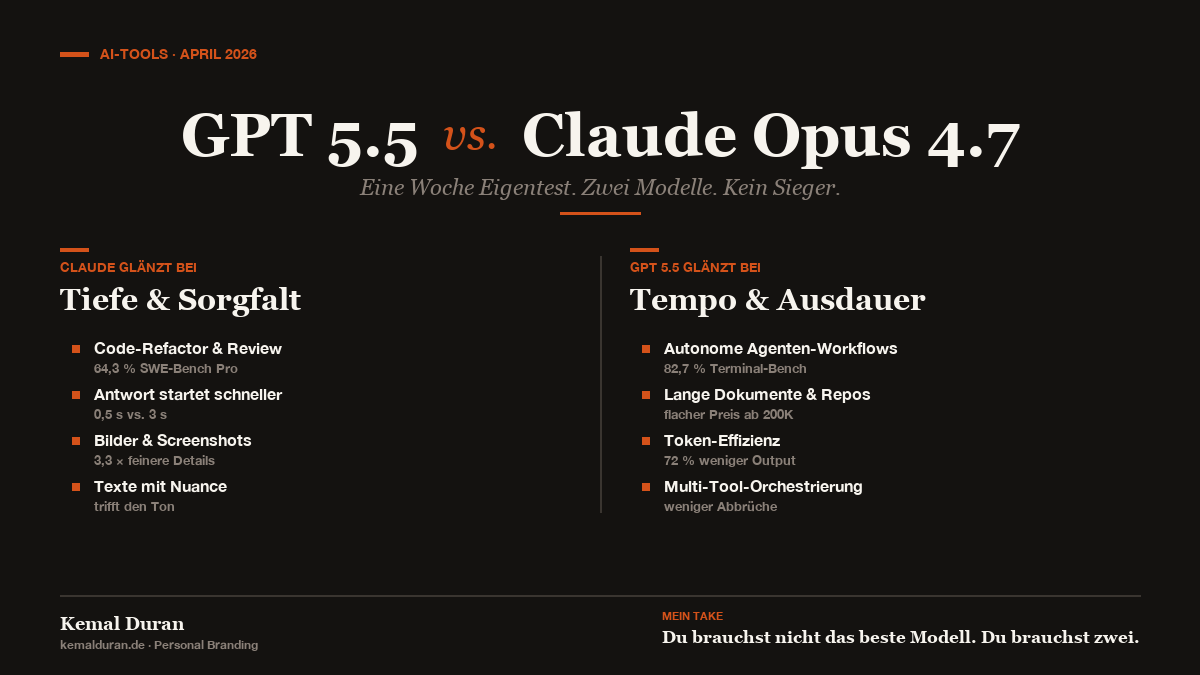
What happened this week:
Within seven days, Anthropic and OpenAI both slapped the label "strongest model in the world" on their new releases.
On 16 April: Claude Opus 4.7. On 23 April: GPT 5.5.
Sounds like a classic showdown. It isn't. Both are right, and both are talking past each other.
I ran both side by side for a week. Real work: writing code, copy for clients, an agent workflow that runs through ten tools at night. Here's what I learned, without the fanboy noise, without the hype goggles.
The two-employee metaphor:
Picture yourself choosing between two employees.
One of them explains everything he's doing. Mutters to himself, notes down every decision, tacks a neat summary on at the end. Seems long-winded. But when you inspect his cabinet: every screw is in place. He even finds the ones you wouldn't have spotted yourself.
The other one barely talks. Clicks through your system on his own, finishes ten tasks in a row, uses 70% fewer words. Done faster. On a complex coding task you'll occasionally find a loose screw, but he gets through three cabinets while the other one is still explaining the first.
Employee A is called Claude Opus 4.7. Employee B is called GPT 5.5.
That's the whole story in one picture. The rest is just numbers that back it up.
Where Claude Opus 4.7 is ahead:
Real coding tasks from real Github repos. Anthropic scores 64.3% on SWE-Bench Pro, the hardest coding test out there right now. GPT 5.5 sits at 58.6%. Sounds like a thin lead. It isn't. On this test, 5.7 points is a whole floor.
What that means in practice: When you do a big refactor where ten files depend on each other. When you need a code review that looks closely and doesn't stop at "looks good". When you start hunting a bug and don't know which file it's hiding in. Claude finds it.
Reading images is the other discipline where Claude is clearly on top. It picks up 3.3 times more detail in a screenshot. So say you photograph a crooked Excel dump and type "summarize the columns for me". Claude reads, GPT guesses.
And response time. Claude answers in 0.5 seconds. GPT needs three. Sounds trivial. It isn't. If you ask something quick 50 times a day, that adds up to two minutes of waiting every day. Not much. But you feel it.
Where GPT 5.5 is ahead:
Autonomous workflows. Exactly the thing Anthropic invented in the first place, and where OpenAI has now pulled ahead.
On Terminal-Bench 2.0 (it measures how well a model works on its own inside a terminal), GPT 5.5 scores 82.7%. Claude scores 69.4. That's a gap of 13 points. The biggest lead any model holds in a single discipline right now.
What that means in real life: If you start an agent that should run through ten tools overnight (sorting mail, pushing data into Sheets, sending out reports, restarting itself after an API error), then you want GPT 5.5. It isn't smarter. It's more stubborn. Gives up less often. Finds its own ways around problems.
Token efficiency is the second big point. For the same task, GPT 5.5 produces 72% less output. Sounds like hair-splitting. But it's real money once you run thousands of tasks a month.
Think of it like this: Claude is the colleague who sends you a tidy email with a summary after every meeting. Nice for the records. Expensive for your inbox. GPT 5.5 sends you a list of what got done at the end of the week. More efficient. Harder to trace.
What the fun costs:
Claude Opus 4.7 costs $5 per million input tokens and $25 per million output tokens.
GPT 5.5 costs $5 for input and $30 for output.
At first glance: Claude is cheaper. At second glance: GPT 5.5 produces less output, so if you push thousands of tasks through it, GPT 5.5 ends up cheaper despite the higher unit price.
But watch out: Claude doubles its price once you go above 200,000 tokens of context. GPT 5.5 doesn't. If you work with long documents, contracts, entire books, complete codebases, you're better off with GPT.
Sounds complicated. It is. That's exactly why both can honestly say "cheaper than the other one". It depends on the workflow.
Where I use which one:
Client copy, storytelling, branding concepts: Claude. Not because GPT writes badly. Because Claude hits my tone without me steering it three times. It has more patience for subtleties and less of a pull toward the "pleasant standard marketing tone" I can't stand.
Code that really has to get built: Claude. Refactors, code reviews, bug hunts. That's where it wins for me every time.
Agents that should run on their own: GPT 5.5. A newsletter workflow that starts every Sunday. An SEO analysis that runs through a hundred URLs. Research tasks where the model decides for itself what it needs next.
Quick question and answer, short bits of help: Claude. You notice the half-second head start on the first reply when you're working in a rush.
Analyzing long documents, reading entire codebases: GPT 5.5. The flat price on long contexts is a real advantage.
The sentence that saved my week:
You don't need "the best AI provider". You need two.
If you have both, you know when to use which. If you only have one, you bend your problems until your own tool fits. That's exactly the more expensive route: hours of your life, not money.
Both have Plus plans for around $20 a month. $40 for access to two frontier models is ridiculously little for what they can do. I know people who spend more on their weekly groceries.
What this means for you:
If you're a freelancer or solo business owner, produce content, write code or automate workflows, then the first thing you do now is this: stop choosing between the two.
Get Claude for the things where depth counts. Get GPT 5.5 for the things where stamina counts. Try both on your real work, not on Twitter demos.
After two weeks you'll know which one is your senior and which one is your intern. And what you need each of them for.
The question is no longer "GPT or Claude?". The question is: Which of your tasks belong in which hands?
And honest question: Are you still trying to decide, or have you already started using both?
FAQ
Which is better, GPT 5.5 or Claude Opus 4.7?
Neither one is better across the board. They are specialized for different tasks. Claude Opus 4.7 leads on real code reviews, bug hunting and reading images or screenshots. GPT 5.5 leads on autonomous workflows that have to run through many steps without anyone stepping in, and it uses less output while doing so.
What does Claude Opus 4.7 cost compared to GPT 5.5?
Claude Opus 4.7 costs $5 per million input tokens and $25 per million output tokens. GPT 5.5 also costs $5 for input, but $30 for output. On top of that, Claude doubles its price once you go above 200,000 tokens of context. GPT 5.5 doesn't.
What is SWE-Bench Pro?
SWE-Bench Pro is a test that puts language models up against real tasks from real Github repos. It currently counts as one of the hardest coding benchmarks. Claude Opus 4.7 reaches 64.3% there, GPT 5.5 gets 58.6%. On this test, the gap of 5.7 points counts as large.
Which tasks is GPT 5.5 especially good for?
GPT 5.5 is especially good for autonomous agent workflows that should complete many steps in a row without constant check-ins, such as overnight automations across several tools. On Terminal-Bench 2.0, GPT 5.5 reaches 82.7% versus 69.4% for Claude. GPT 5.5 also produces 72% less output for the same task. That saves money when you run many tasks.
Do I really need both AI models at the same time?
You don't have to, but it makes sense if you have different types of tasks. Both providers offer Plus plans for around $20 a month, so about $40 together for access to two frontier models. People who only use one model often bend their own tasks to fit its strengths, instead of picking the right tool for each job.