China 2030: What you need to know now, before your market reshuffles
The model that works until it collapses
There are companies that sell at zero margin.
Not because they want to. Because their state fears unemployment more than red ink.
This is not an isolated case in China. It's a principle of the system.
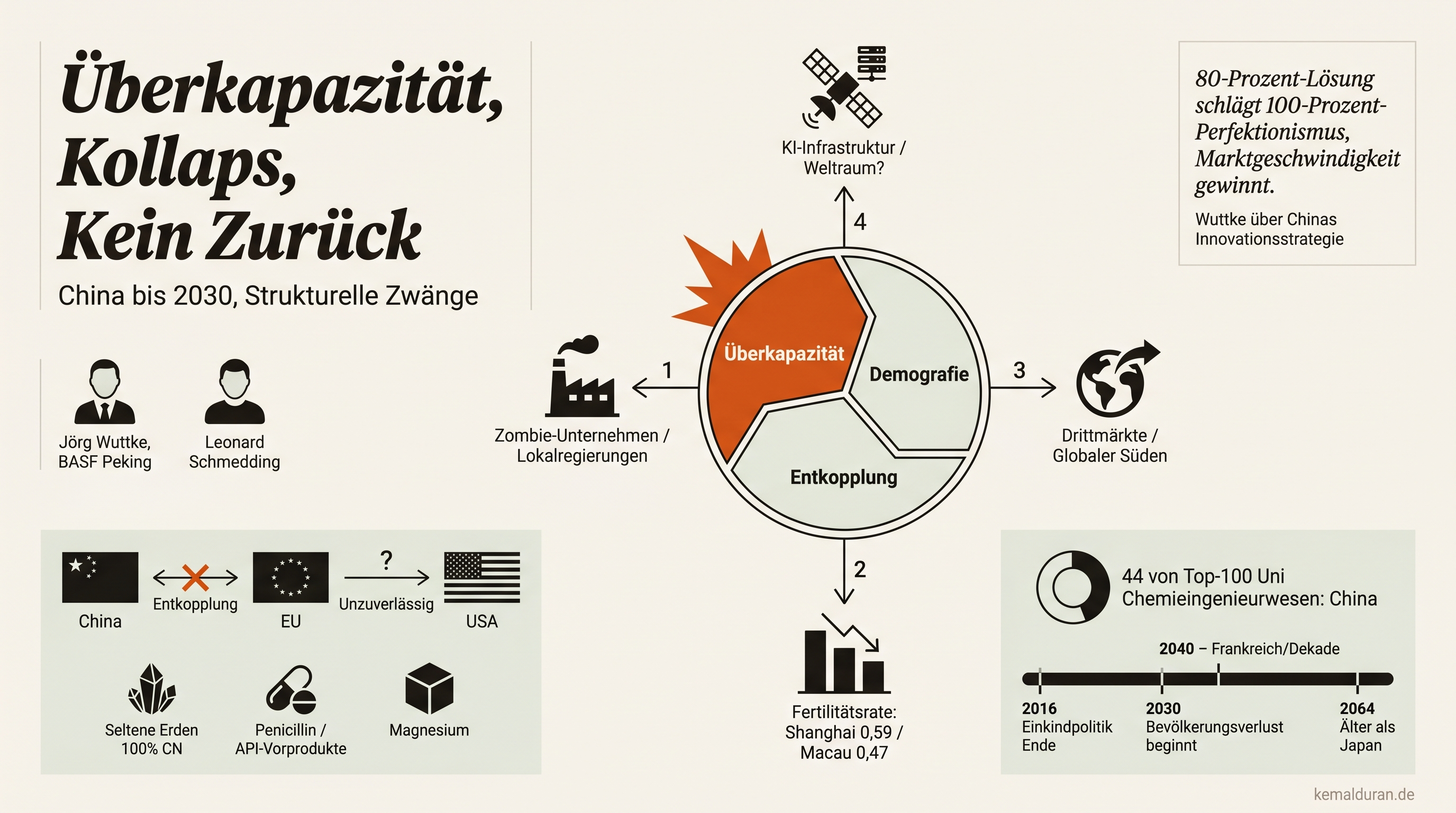
State-owned enterprises don't go bankrupt. Provincial governors would rather keep factories running at zero margin than put thousands out on the street. The result: zombie companies that hang on the drip of local politics and have to pump their overproduction into exports. Not as a strategy. As a survival mechanism.
A former Chinese minister summed it up back in 2016: Everything China plans ends in overcapacity.
Not cyclical. Structural.
If you understand that, you also understand why Chinese cars, batteries and solar panels have been entering European markets for three years with a price pressure that no German controlling model could have predicted.
Three engines, one still running
The Chinese economy had three growth engines.
Real estate. Domestic demand. Investment.
All three are currently cold, or hot enough to catch fire.
Real estate prices have fallen by 40% since the peak. Chinese households have collectively lost more than a trillion dollars in wealth, tied up in square meters that are now worth less than the loan behind them. Fixed asset investment has been practically frozen on orders from the top since summer 2024. And domestic demand? 900 million people in China have less than ten dollars a day to live on. Consumer growth needs a middle class. That class is still too thin.
What is still firing: exports.
And that's the problem for anyone working in an industry that overlaps with China.
Chemicals. Automotive. Solar. Batteries. Mechanical engineering. If you operate there, you should from now on expect Chinese competitors to have a structural cost advantage of about 20%, a mix of deflation and an undervalued currency. Not as an exception. As the new baseline.
The 80% principle that beats Europe
I've been watching this for years in different projects.
German companies develop products to 100%. Test to 100%. Launch when everything is perfect.
Chinese companies launch at 80%. Iterate in the market. Learn faster than their competitors can develop.
This is not sloppiness. It's a deliberate market speed strategy.
If you wait for customer feedback before you launch, you lose exactly the window in which customer feedback can still make a difference. By then the market has moved on.
The 80% principle is not an invention from the Far East. It's iteration logic, the same logic behind every sensible software release cycle. China's industry just put it into practice more consistently than anyone else.
Ship the next feature earlier. Use customer feedback as an engine for development, not as a sign-off criterion afterward. Test the market before the product is finished.
If you don't do that, you wait for perfection while the competition maps the market.
Demographics is not a forecast. It's math.
In Shanghai, the fertility rate is 0.59.
Not 1.5. Not 0.9. 0.59.
This is not a trend line. It's a demographic collapse in slow motion. From 2030 on, China loses roughly the population of France every decade. By the middle of the century, the average Chinese person will be older than the average European. By 2064, older than the average Japanese person.
And Japan already counts as the extreme case among aging societies today.
The answer China is planning: AI and robotics as a productivity substitute. Automated nursing homes are running as pilot projects. Medical diagnostic booths detect conditions with 98% accuracy, based on 350 million data points.
Whether that's enough is open. The demographic math won't wait for the answer.
What this means for business owners: If you want to grow in China, you have to understand that China's main domestic problem in five years won't be called geopolitics. It will be called aging, a shrinking workforce, and a party that is getting older than its own population.
The real battlegrounds
Europe watches China as a market or as a supplier.
Wrong perspective.
The real battlegrounds are somewhere else. Africa. Southeast Asia. South America.
That's where China has been building infrastructure, trade routes and market presence for years. That's where European products run into Chinese suppliers with a cost advantage that no lobbying in Brussels will fix.
If you're active in these regions with German or European products, or plan to be, you need an honest analysis now: How much of a price advantage can I communicate? Where is the real lever for standing apart? Quality alone is no argument when the price difference for the end customer is 30%.
Extend your market monitoring to these regions. Don't wait until the pressure shows up in Europe. That comes second.
What this means for AI and digital infrastructure
China's technology agenda has one feature that many underestimate.
Its strength isn't basic research. Its strength is development depth.
Innovation happens where demand meets engineering capacity. China has the deepest engineering base in the world. Almost half of the top 100 universities in chemical engineering are in China. And Chinese tech companies have a culture that puts product iteration above product perfection.
For SaaS builders and product teams in Europe, that means in concrete terms: The question is not whether China will offer AI applications in Europe at some point. The question is in which verticals that happens first. Medical diagnostics, nursing care, autonomous systems: the pilot projects are running. Scale will follow.
If you build in these fields, don't treat Chinese developments as a distant competitive scenario. Treat them as mandatory market intelligence.
And if your production supply chains depend on magnesium, pharmaceutical precursors or rare earths: these dependencies can change at short notice. Export controls get used as a geopolitical lever, on top of their role in trade policy. Buffer stocks and alternative suppliers aren't a luxury. They are insurance against operational risk.
The question nobody asks out loud
China's economic model is stuck in a bind.
Export pressure is rising because three domestic engines are cold. Demographics weaken the labor base in the long run. Technology is supposed to make up for that, but the gap in semiconductors is real, and the dependence on Western chips hasn't been fully resolved yet.
That's no argument for sounding the all-clear. It's an argument for precision.
China 2030 won't be the collapsed giant some predict. And it won't be the unlimited growth machine others promise.
It will be a system under pressure that exports its pressure outward, in the form of prices, of products and of geopolitical maneuvers.
Anyone who understands this now has a head start.
Not because they know China better than others. Because they stopped putting it in the wrong box.
FAQ
Why are Chinese products often so much cheaper than European ones?
One major reason is zombie companies. These are businesses close to the state that keep producing despite being in the red, because provincial governments want to avoid unemployment. The overproduction that results gets pushed into exports, often at zero margin. On top of that comes a structural undervaluation of the currency. That widens the price advantage even more.
What does the low fertility rate in Shanghai mean in concrete terms?
A fertility rate of 0.59 means that on average fewer than one child is born per woman, far below the value of about 2.1 that keeps a population stable. In the long run, this leads to a shrinking and fast aging population. In China, the problem adds pressure on the workforce, pension systems and economic growth all at once.
What is the 80% principle in Chinese product development?
The 80% principle describes a strategy of bringing products to market at around 80% completion instead of waiting for one hundred percent perfection. That way you collect real customer feedback earlier and can adjust faster than competitors who are still developing. It isn't sloppiness. It's a deliberate speed strategy, similar to iterative software releases.
Which industries are hit hardest by China's cost advantage?
Chemicals, automotive, solar, batteries and mechanical engineering are hit especially hard. According to the article, companies in these industries should expect a structural cost advantage of about 20% for Chinese suppliers. This advantage comes from domestic deflation and an undervalued currency, and it counts as a lasting condition, not a temporary exception.
Where does the real competition between China and European companies happen?
The decisive competition doesn't happen directly in Europe. It happens in third markets like Africa, Southeast Asia and South America. That's where China has been deliberately building infrastructure and trade routes for years, and where it meets European suppliers with a clear price advantage. If you're active in these regions or want to be, factor this competitive situation into your market analysis now.